You were doing so well.
Days without smoking. Maybe weeks. Maybe even months.
You felt strong. You felt proud. You felt like you were finally free.
And then something happened.
A stressful moment. A trigger you weren’t ready for. A split second where your guard dropped.
And you smoked.
Now you’re sitting here feeling like you ruined everything. Like all that progress is gone. Like you have to start over from zero.
You’re angry at yourself. Disappointed. Ashamed.
Maybe you’re already thinking: “I knew I couldn’t do it. I’m never going to be able to quit.”
But here’s what I need you to hear:
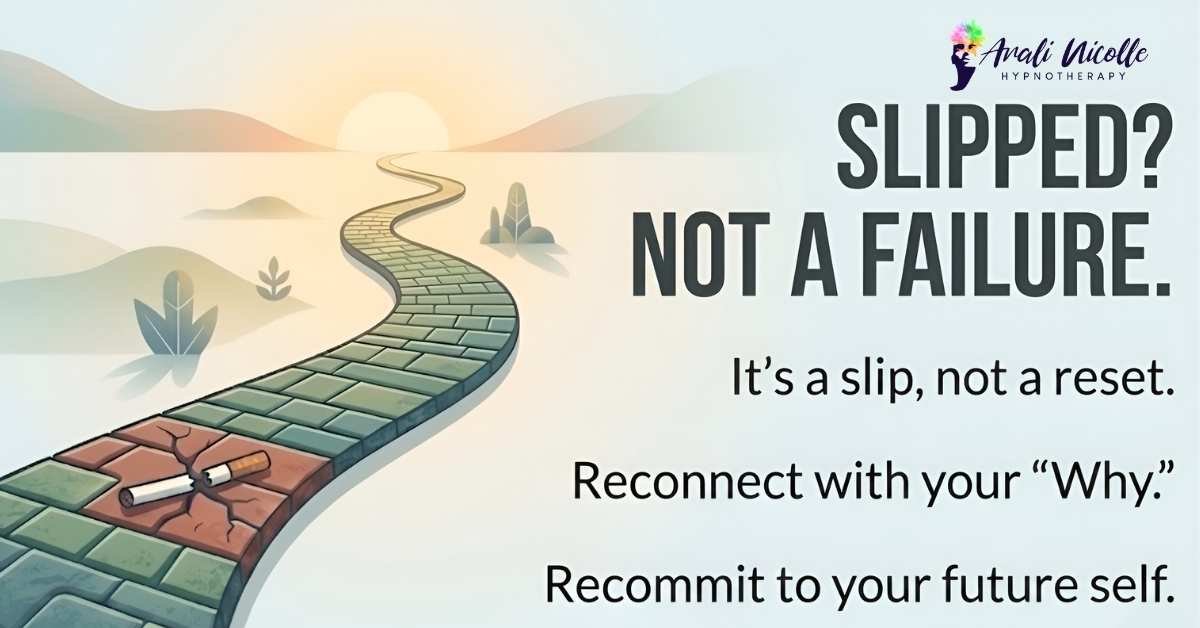
One cigarette doesn’t mean you failed.
It doesn’t erase your progress. It doesn’t mean you’re back to square one. And it doesn’t mean you’re weak or broken or destined to be a smoker forever.
Let me explain what’s actually happening—and what to do next.
Table of Contents
Why One Cigarette Doesn’t Mean You Failed
When you slip and have a cigarette after quitting, your brain immediately goes into all-or-nothing thinking:
“I smoked. That means I failed. I’m back to being a smoker. I might as well keep smoking.”
But that’s not true.
Here’s what’s actually true:
You’ve been smoke-free for [days/weeks/months]. One cigarette doesn’t erase that.
Think about it this way:
If you were trying to get healthier and you ate one donut, would that erase all the healthy meals you’d eaten? Would it mean you’re “back to being unhealthy”?
No. It would mean you ate a donut. And then you’d move on.
Smoking one cigarette is the same thing. It’s a moment. A slip. Not a complete reset.
You haven’t lost all your progress. You haven’t undone everything. You haven’t gone back to being the person you were when you were smoking every day.
You’re still the person who quit. You just had a cigarette.
And what you do next is what matters.
What’s Really Happening When You Slip (It’s Not Weakness)
Let’s talk about what’s actually happening in your brain when you slip.
You didn’t smoke because you’re weak. You didn’t smoke because you “don’t want it badly enough.”
You smoked because your brain is still running old programming.
Here’s what happened:
Your Brain Tested the Old Pattern
When you quit smoking, you’re not just eliminating a physical addiction. You’re rewiring thousands of subconscious associations.
Your brain has learned: stress → cigarette, coffee → cigarette, social situation → cigarette.
Even after you quit, those pathways are still there. They’re just dormant.
And when you encounter a strong trigger, especially one you weren’t prepared for, your subconscious can default to the old pattern.
It’s not a conscious decision. It’s autopilot.
Your brain ran the program it’s been running for years: “This situation = cigarette.”
And before you even realized what was happening, you were smoking.
You Experienced a Moment of Depleted Willpower
Maybe you’d been resisting cravings all day. Maybe you were tired, stressed or emotionally overwhelmed.
In that moment, your conscious mind, the part that wants to quit, was exhausted. And your subconscious mind, the part that remembers cigarettes as relief, took over.
That’s not a weakness. That’s how the brain works.
You Encountered an Unexpected Emotional Trigger
Maybe something happened that brought up emotions you didn’t know how to process without smoking.
For years, cigarettes have been your coping mechanism. Your way to manage stress, anxiety, anger and sadness.
And in that moment, you reached for the tool you’ve always used.
Not because you’re failing. But because you haven’t fully developed new tools yet.
The Difference Between a Slip and a Relapse
Here’s what a lot of people don’t understand:
A slip and a relapse are not the same thing.
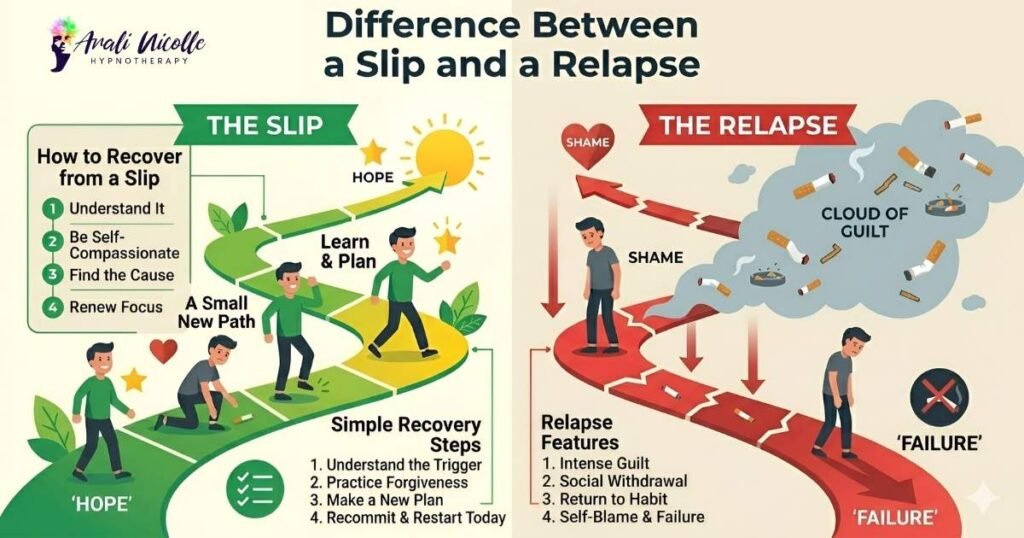
A Slip Is:
- Smoking once or a few times after a period of being smoke-free
- Usually triggered by a specific situation or emotion
- Followed by getting back on track
A Relapse Is:
- Going back to regular smoking patterns
- Giving up on quitting entirely
- Deciding “I failed, so I might as well keep smoking.”
A slip is a moment. A relapse is a decision to return to the old behavior.
Right now, you’ve had a slip. Not a relapse.
And whether this becomes a relapse or not depends entirely on what you do next.
Why Shame Makes It Worse (And What to Do Instead)
Let me tell you what happens when you respond to a slip with shame:
You smoke a cigarette. You feel terrible. You beat yourself up.
“I’m so weak. I can’t believe I did this. I ruined everything.”
And then, because you already “failed,” you think: “What’s the point? I might as well smoke another one.”
So you do.
And then another. And another.
And within a day or two, you’re back to smoking regularly.
This is the shame spiral. And it’s the #1 reason slips become relapses.
Shame doesn’t motivate you to do better. It convinces you that you’ve already failed, so there’s no point in trying.
Here’s what to do instead:
Step 1: Acknowledge What Happened Without Judgment
“I smoked a cigarette. That happened.”
Not: “I’m a failure.”
Not: “I’m weak.”
Not: “I knew I couldn’t do it.”
Just: “I smoked a cigarette.”
State the fact without attaching a story to it.
Step 2: Get Curious, Not Critical
Instead of beating yourself up, ask yourself:
- What was happening right before I smoked?
- What was I feeling?
- What triggered this?
- What need was I trying to meet?
This isn’t about blame. It’s about understanding.
Every slip gives you information about where you still need support.
Step 3: Respond With Self-Compassion
Talk to yourself the way you’d talk to a friend who slipped:
“You’ve been doing so well. You had a hard moment and you reached for the old tool. That’s understandable. It doesn’t erase your progress. You can get back on track right now.”
Self-compassion doesn’t mean letting yourself off the hook. It means treating yourself with the kindness that actually helps you move forward.
What Your Brain Is Doing Right Now (And How to Respond)
Right now, your brain is at a crossroads.
It just re-experienced smoking. And now it’s deciding: “Was that a one-time thing? Or are we going back to smoking?”
Here’s how your brain makes that decision:
If You Respond With Shame and Give Up:
Your brain interprets that as: “Oh, we’re smoking again. Let me reactivate all the old pathways.”
The associations strengthen. The cravings come back. You’re back to square one.
If You Respond With Compassion and Recommit:
Your brain interprets that as: “That was an anomaly. We’re still non-smokers.”
The associations stay dormant. The slip doesn’t turn into a pattern. You stay on track.
The way you respond in the next 24 hours determines which path you take.
So here’s what you need to do:
Don’t Smoke Again
I know that sounds obvious, but this is critical.
One cigarette is a slip. Two cigarettes are the beginning of a pattern.
Don’t let your brain think smoking is back on the table.
Reconnect With Your “Why”
Why did you quit in the first place?
Your health? Your kids? Your self-respect? Your freedom?
Remind yourself of that reason. Write it down. Say it out loud.
That’s your anchor.
Address the Trigger
What happened right before you smoked?
If it was stress, how can you manage stress differently next time?
If it were a social situation, how could you prepare for that situation in the future?
If it was an emotional trigger, what support do you need to process those emotions without smoking?
Don’t just move on and hope it doesn’t happen again. Learn from it.
Recommit Right Now
You don’t have to wait until tomorrow to “start over.”
You don’t have to set a new quit date.
You can recommit to being a non-smoker right now, in this moment.
The cigarette you smoked is in the past. What you do next is the only thing that matters.
How to Get Back on Track Without Starting Over
Here’s what you need to understand:
You don’t have to start over.
You didn’t lose all your progress. Your body didn’t reset to “smoker mode” after one cigarette.
All the benefits you’ve gained from not smoking, such as better lung function, improved circulation and increased energy are still there.
All the days you went without smoking still count.
You’re not back at day zero. You’re at day [however many days you’ve been smoke-free] plus one slip.
That’s it.
So here’s how to move forward:
Treat This as a Learning Experience
Every slip teaches you something about your triggers, your needs, and where you need more support.
What did this slip reveal?
Use that information to strengthen your quit.
Don’t Wait to “Earn” Your Non-Smoker Identity Back
You didn’t lose your identity as a non-smoker because you had one cigarette.
You’re still someone who doesn’t smoke. You just had a moment where you slipped.
The faster you reconnect with that identity, the easier it is to get back on track.
Reach Out for Support
If you’ve been trying to quit on your own and you slipped, that’s a sign you might need more support.
Talk to someone who understands. Join a support group. Work with a professional who specializes in smoking cessation.
You don’t have to do this alone.
Strengthen the Weak Point
Where did the slip happen?
Was it a situation you weren’t prepared for? An emotion you didn’t know how to handle? A trigger you underestimated?
Now you know where the weak point is. Strengthen it.
Build new coping skills. Practice different responses. Get support for that specific challenge.
The One Thing That Determines Whether This Becomes a Full Relapse
Here’s the truth:
The difference between a slip and a relapse is what you do in the next 24 hours.
If you respond with shame, give up, and keep smoking, this becomes a relapse.
If you respond with self-compassion, recommit, and get back on track, this stays a slip.
That’s it. That’s the whole equation.
You have complete control over which direction this goes.
What I Want You to Know Right Now
If you’re reading this after slipping and having a cigarette, I want you to hear this clearly:
You are not a failure.
You’re human. You’re in the middle of rewiring years of subconscious programming. And that process isn’t always linear.
You’ve made incredible progress. You’ve gone [days/weeks/months] without smoking. That’s real. That matters. One cigarette doesn’t erase that.
And here’s what else I want you to know:
Most people who successfully quit smoking long-term had at least one slip along the way.
This isn’t a sign that you can’t quit. It’s a normal part of the process for many people.
The people who succeed aren’t the ones who never slip. They’re the ones who slip, learn from it, and keep going.
You can be one of those people.
What to Do Right Now
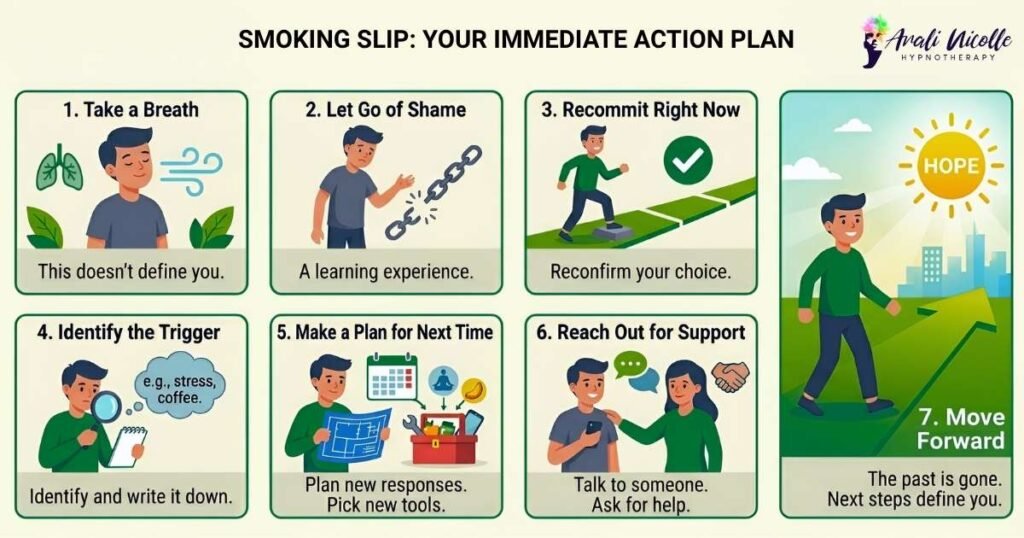
If you slipped and had a cigarette, here’s your action plan:
1. Take a Breath
You’re okay. You’re going to be okay. This doesn’t define you.
2. Let Go of the Shame
You’re not weak. You’re not a failure. You’re a person who’s learning to live without cigarettes, and that’s hard work.
3. Recommit Right Now
You don’t need a new quit date. You don’t need to “start over.” You can recommit to being a non-smoker right now, in this moment.
4. Identify the Trigger
What happened right before you smoked? What were you feeling? What need were you trying to meet?
Write it down. This is valuable information.
5. Make a Plan for Next Time
How will you handle that trigger differently in the future? What support do you need? What tools can you use?
6. Reach Out for Support
Don’t isolate. Don’t beat yourself up alone. Talk to someone. Ask for help.
7. Move Forward
The cigarette you smoked is in the past. You can’t change it. But you can choose what happens next.
And what happens next is entirely up to you.
You’re Stronger Than You Think
Here’s what I know about you:
You wanted to quit badly enough that you actually did it—for days, weeks, or months.
You had a moment where you slipped. But you cared enough to search for answers. To read this. To figure out how to move forward.
That tells me you’re not giving up.
And if you’re not giving up, then this slip is just a moment. Not a destiny.
You’ve already proven you can quit. You did it once. You can do it again.
And this time, you have even more information about what you need to succeed.
You’re not starting over. You’re continuing forward. With more knowledge, more awareness, and more strength than you had before.
One cigarette doesn’t change that.
Ready to quit without the struggle? Book a free Clarity Call.
