
You might still be smoking for a version of your life that ended years ago.
Think about when you started smoking.
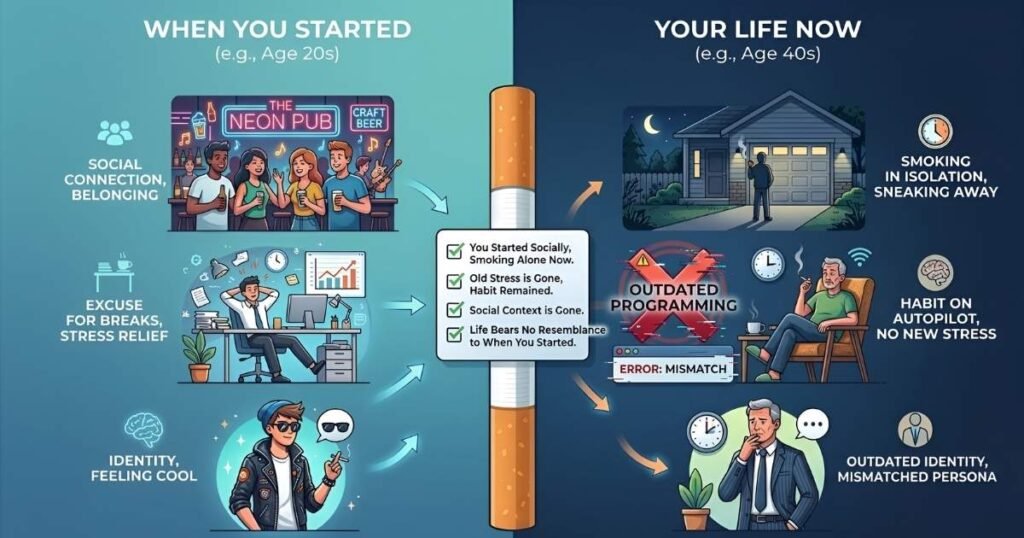
Maybe you were in your early 20s. You were out at bars, at parties, standing outside with friends. Smoking gave you something to do. It created a connection. It made you feel like you belonged.
In that phase of life, smoking made sense.
But that was 20 years ago.
Your life now looks completely different. You’re not standing outside bars anymore. You’re not socializing the same way. That entire chapter is over.
And yet… You still smoke.
Why?
Because your brain formed an association back then, smoking equals connection, belonging, relief and that association never updated.
Even when the context disappeared, the pattern kept running.
So now you’re smoking for reasons that no longer exist.
Not because you actually need cigarettes today. But because your brain is still running outdated programming from a version of your life that’s already over.
Let me explain why this happens and how to finally let go.
Table of Contents
Why Your Brain Holds Onto Old Habits (Even When the Context Changes)
Here’s the psychology behind this:
Your brain learns through association.
When you do the same behavior in the same context repeatedly, your brain creates a link between the two.
Context + Behavior = Association
For example:
- Bar + Cigarette = Connection
- Party + Cigarette = Belonging
- Outside with friends + Cigarette = Relief
After enough repetitions, the association becomes automatic. Your brain doesn’t need to think about it anymore. It just runs the program.
The Problem: Contexts Change, But Associations Don’t Automatically Update
Your life changes. You grow. You move into different phases.
But your brain doesn’t automatically delete old associations just because the context is gone.
Those patterns stay in your subconscious, running in the background unless you actively update them.
So even though you’re not standing outside bars anymore, your brain is still running the old program:
Smoking = connection. Smoking = belonging. Smoking = relief.
And because that program is still active, you keep smoking.
Not because you consciously need it. But because your subconscious hasn’t caught up to your current life.
The Social Smoker Who’s Not Social Anymore
Let me paint you a picture of how this plays out:
Phase 1: Your 20s (The Origin)
You’re young. You’re social. You’re out 3-4 nights a week.
You start smoking because everyone else is smoking. It gives you something to do with your hands. It’s an excuse to step outside. It creates a connection with other smokers.
Smoking becomes woven into your social identity.
Brain association formed: Smoking = social connection, belonging, fun.
Phase 2: Your 30s (The Transition)
Life starts to shift. You’re not going out as much. Maybe you’re focused on your career. Maybe you’re in a relationship. Maybe you have kids.
Your social life looks different. But you still smoke.
Why? Because the association is still there. Smoking still feels like it’s connected to relief, breaks, moments for yourself.
Brain association: Still running the old program, but the context is fading.
Phase 3: Your 40s (The Disconnect)
Your life now bears almost no resemblance to your 20s.
You’re not going to bars. You’re not socializing the same way. That entire phase of your life is over.
And yet… You still smoke.
But now, when you smoke, you’re alone. You’re standing in your garage. Or outside your house. Or sneaking away so no one sees.
The original reason you started social connections doesn’t exist anymore.
But your brain is still running the old association.
And that’s the trap.
Common Life Phases That Create Smoking Habits (That No Longer Apply)
Let’s look at the most common contexts where people start smoking and how those contexts often disappear while the habit stays.
Context #1: The Social Phase (Bars, Parties, Friends)
When it started:
You were young and social. Smoking was part of the scene. It gave you something to do, a way to connect, a sense of belonging.
Brain association formed:
Smoking = fun, connection, social belonging.
What changed:
You’re not going out the same way anymore. You’re not standing outside bars. That social context is gone.
Why do you still smoke?
Your brain never updated the association. It’s still running “smoking = connection” even though you’re smoking alone now.
Context #2: The Stressful Job Phase
When it started:
You started a high-stress job. Smoking gave you an excuse to take breaks. It was the only time you allowed yourself to step away.
Brain association formed:
Smoking = permission to pause, stress relief.
What changed:
Maybe you left that job. Maybe the job got less stressful. Maybe you’re retired. The context that created the need is gone.
Why do you still smoke?
Your brain is still running “smoking = break” even though you don’t need that excuse anymore.
Context #3: The Identity Phase (Rebellion, Independence, Edge)
When it started:
You were a teenager or in your early 20s. Smoking made you feel cool, rebellious and independent. It was part of the persona you created.
Brain association formed:
Smoking = who I am, confidence, edge.
What changed:
You’ve grown. You’ve matured. That identity is no longer relevant. You’re not trying to prove anything anymore.
Why do you still smoke?
Your brain is still running “smoking = me” even though that version of you is long gone.
Context #4: The Coping Phase (Trauma, Loss, Chaos)
When it started:
You were going through something hard, maybe a breakup, a death or a chaotic period. Smoking helped you cope.
Brain association formed:
Smoking = coping mechanism, emotional relief.
What changed:
You’ve healed. You’ve moved on. The crisis is over.
Why do you still smoke?
Your brain is still running “smoking = coping” even though you don’t need it to cope anymore.
Why the Association Keeps Running Even When the Reason Is Gone
Here’s the key insight:
Your brain doesn’t automatically delete associations just because the context changes.
Think of it like old files on your computer. Just because you don’t use them anymore doesn’t mean they disappear. They’re still there, taking up space, unless you actively delete them.
Brain associations work the same way.
The association “smoking = connection” doesn’t disappear just because you’re not social anymore.
The association “smoking = relief” doesn’t disappear just because the stressful situation is over.
Those patterns stay in your subconscious until you actively update them.
Why Your Brain Holds Onto Old Patterns
Your brain is designed to be efficient. It automates patterns so you don’t have to think about everything you do.
Once a pattern is established, your brain defaults to it even if the original context is gone.
Because from your brain’s perspective: “This pattern worked in the past. Why change it?”
Your conscious mind might know: “I don’t need cigarettes anymore. That phase of my life is over.”
But your subconscious mind is still running: “Smoking = connection/relief/belonging. Keep doing it.”
And subconscious programming always wins over conscious understanding.
Signs You’re Smoking for a Version of Your Life That No Longer Exists
How do you know if you’re smoking for outdated reasons?
Here are the signs:
Sign #1: You Started Smoking in a Specific Social Context That No Longer Applies
You started smoking at bars, parties, or with a specific group of friends.
But you’re not in that context anymore. You’re not socializing that way. And yet you still smoke.
Sign #2: You Smoke Alone Now, But You Started Smoking Socially
If you started smoking because it created a connection, but now you smoke in isolation, that’s a mismatch.
The reason is gone. But the habit stayed.
Sign #3: The Stressful Situation That Led to Smoking Is Over
Maybe you started smoking during a particularly stressful job, relationship, or life phase.
But that situation is over. And you’re still smoking.
Sign #4: You Can’t Remember Why You Still Smoke
When you ask yourself, “Why do I smoke?” you don’t have a clear answer.
It’s not stress (you have other ways to manage that now). It’s not social (you’re not in those situations anymore). It’s not enjoyment (you don’t even like it).
You just… do it.
That’s a sign the habit is running on autopilot from an outdated association.
Sign #5: Your Life Looks Completely Different Than When You Started
If your life in your 40s or 50s bears almost no resemblance to your life in your 20s, but you’re still smoking the same way, that’s a clear sign.
The context changed. But the pattern didn’t.
How to Update Your Brain and Let Go of Outdated Patterns
So how do you actually update these old associations?
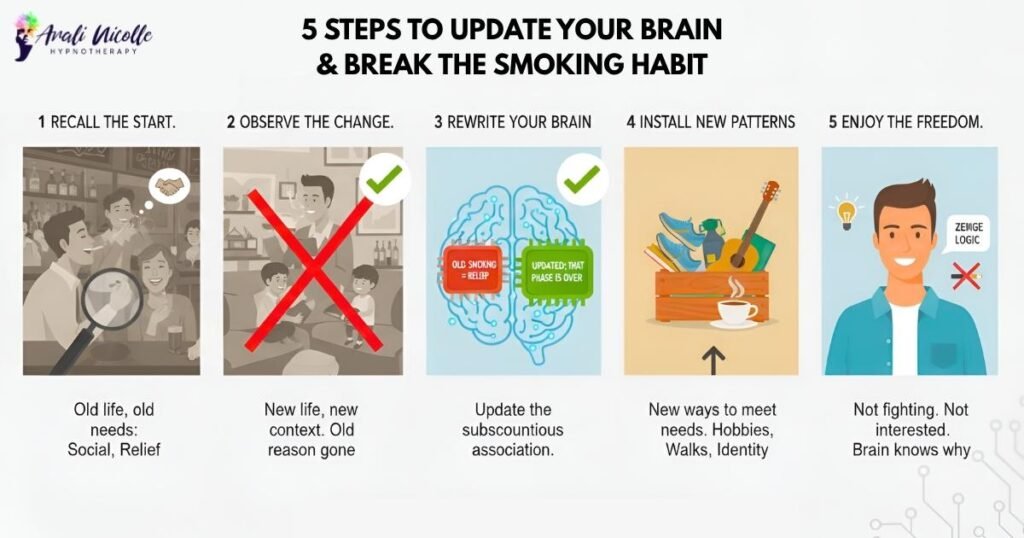
Step 1: Identify the Original Context
Ask yourself:
- When did I start smoking?
- What was my life like then?
- What did smoking give me in that context?
Be specific. Was it a connection? Belonging? Relief? A break? An identity?
Step 2: Acknowledge That the Context Is Gone
Look at your life now. Are you still in that same context?
If not, name what’s changed:
- “I’m not going out to bars anymore.”
- “I’m not in that stressful job anymore.”
- “I’m not trying to fit in anymore.”
- “I’m not in that chaotic phase anymore.”
This creates conscious awareness that the reason no longer exists.
Step 3: Update the Association at the Subconscious Level
Here’s where most people get stuck.
You can consciously know the reason is gone. But knowing doesn’t update the subconscious association.
That’s where hypnotherapy comes in.
Through hypnotherapy, we access your subconscious and update the outdated pattern:
Old association: Smoking = connection/belonging/relief
Updated understanding: That phase is over. I don’t need smoking for that anymore.
We don’t just tell your conscious mind. We update the subconscious programming.
Step 4: Install a New Pattern
It’s not enough to just delete the old association. Your brain needs something to replace it with.
If smoking was your way to feel connected, what’s the new way?
If smoking was your break, how do you take breaks now without needing a cigarette?
If smoking was part of your identity, who are you without it?
We install new patterns that meet the same needs without cigarettes.
Step 5: The Old Pattern Stops Making Sense
Once the subconscious association is updated, something shifts.
You’re not fighting the urge to smoke. You’re just… not interested.
Because the reason you were smoking is gone. And your brain finally knows it.
What Changes When You Stop Smoking for a Life That’s Already Over
Here’s what happens when you update the outdated pattern:
You Stop Feeling Like You’re Giving Something Up
When you’re smoking for an old association, quitting feels like a loss.
“I’m giving up my connection / my relief / my break / my identity.”
But when you update the pattern, you realize: “I’m not giving up anything. That reason doesn’t even exist anymore.”
Quitting stops feeling like deprivation. It feels like letting go of something you’ve been carrying that you don’t need.
Smoking Stops Making Sense
You might catch yourself thinking: “Why was I even doing that?”
Because once the association updates, the behavior loses its logic.
It’s like keeping an umbrella open inside your house because it was raining yesterday. It made sense then. But now? It’s just unnecessary.
You Feel Lighter
There’s a relief that comes with letting go of outdated patterns.
You’ve been carrying a habit from a version of your life that’s over. And now you can finally put it down.
You Reconnect With Who You Actually Are Now
Smoking kept you tethered to an old version of yourself.
Once you let it go, you get to fully step into who you are now—not who you were 20 years ago.
The Real Question Isn’t “Why Can’t I Quit?” It’s “Why Am I Holding Onto a Habit From a Life That’s Over?”
If you’re still smoking in your 40s, 50s, or beyond and your life looks nothing like it did when you started, ask yourself this:
What version of my life am I still smoking for?
Are you smoking for the 22-year-old standing outside a bar with friends?
Are you smoking for the version of you who needed a break during that stressful job phase?
Are you smoking for the identity you created when you were younger?
Because if that version of your life is gone and it probably is then you’re smoking for a reason that no longer exists.
And once you see that clearly, the habit stops making sense.
Your brain just needs to catch up to your current life.
And when it does, letting go becomes natural.
Ready to quit without the struggle? Book a free Clarity Call.
