

You’ve read the books. Allen Carr. The Easy Way to Stop Smoking. Maybe more than once.
You’ve tried cold turkey multiple times.
You’ve downloaded the apps. You’ve watched the YouTube videos. You’ve listened to the podcasts.
You’ve tried nicotine patches, gum, lozenges. You’ve set quit dates. You’ve thrown away packs.
And you’re still smoking.
So what does that mean?
Does it mean you’re broken? That you’re not trying hard enough? That you don’t actually want to quit?
No.
If you’ve tried several times and keep going back to cigarettes, professional help to quit smoking is a reasonable next step. You don’t need to wait for a certain number of attempts. A primary care clinician or tobacco quitline can help you look at what happened last time and make a quit plan around the moments that caught you off guard.
Nicotine dependence, daily routines, and the relief you associate with a cigarette can all play a part. You might need different tools for each one.
Let me explain when DIY methods work, when they don’t and what to do instead.
Table of Contents
When to Ask for Help to Quit Tobacco
Let me be clear from the start: DIY methods absolutely work for some people.
Books like Allen Carr’s The Easy Way to Stop Smoking can give you a different way to think about cigarettes. Apps can help you notice when you reach for one. The useful question is what each tool does for you: a book might change your expectations, while a tracker might show that half the cigarettes you smoke happen in the car.
So when do they work?
Self-guided tools can help you spot patterns and plan what to do instead.
What “Thought-Driven” Smoking Looks Like:
- You picked up smoking casually at parties, socially, occasionally
- You can go days without smoking and not think about it
- Smoking is a habit you do automatically, but there’s no deep emotional attachment
- You smoke because “everyone does” or because it’s convenient, not because you need it
- You’ve never used smoking to cope with stress, trauma, or overwhelming emotions
- You don’t identify strongly as a smoker
If this describes you, then quitting is mostly about:
- Reframing your thoughts about smoking
- Breaking the automatic pattern (morning cigarette, after-meal cigarette)
- Understanding the logic of why smoking doesn’t actually provide what you think it does
Try changing one cue first. If you usually smoke right after lunch, decide where you’ll go when you finish eating. A short walk with a colleague may be easier to repeat than a promise to “be stronger” when you’re standing beside the smoking area.
Notice whether the new routine is enough or whether you still feel a strong craving away from the usual setting.
The Social Smoker vs. The Dependent Smoker
Here’s a good litmus test:
If you smoke mainly around friends, look at what happens between those occasions. Even occasional tobacco use is worth discussing if you’re having trouble stopping.
Daily smoking, a cigarette soon after waking, or repeated attempts that end during the first week can give a clinician clues about nicotine dependence.
The point isn’t to put yourself into a category. It’s to find the kind of help that fits what happens in your day.
How Nicotine and Tobacco Use Affect Daily Routines
Let me explain what I mean by “conscious habit” vs. “subconscious pattern.”
Conscious Habit:
A behavior you do automatically, but it’s not tied to emotional need or identity. You could stop it with awareness and intention.
Example: Biting your nails when you’re bored. Scrolling social media before bed. Ordering the same coffee every day.
These habits are autopilot behaviors, but they’re not protecting anything deep. They’re just patterns your brain has learned.
Subconscious Pattern:
By “subconscious pattern,” I mean a response that can feel automatic, such as wanting a cigarette when your phone rings with a stressful call. It’s a way to describe the experience, not a diagnosis or a separate type of tobacco dependence.
Example: Smoking when you’re stressed because that’s how you learned to calm your nervous system 15 years ago. Smoking because it’s tied to who you believe you are. Smoking because it’s the only way you know how to regulate overwhelming emotions.
These patterns aren’t just habits. They’re protective mechanisms.
And you can’t eliminate a protective mechanism with logic alone.
Signs You Need Support to Stop Smoking
So how do you know if your smoking is subconscious?
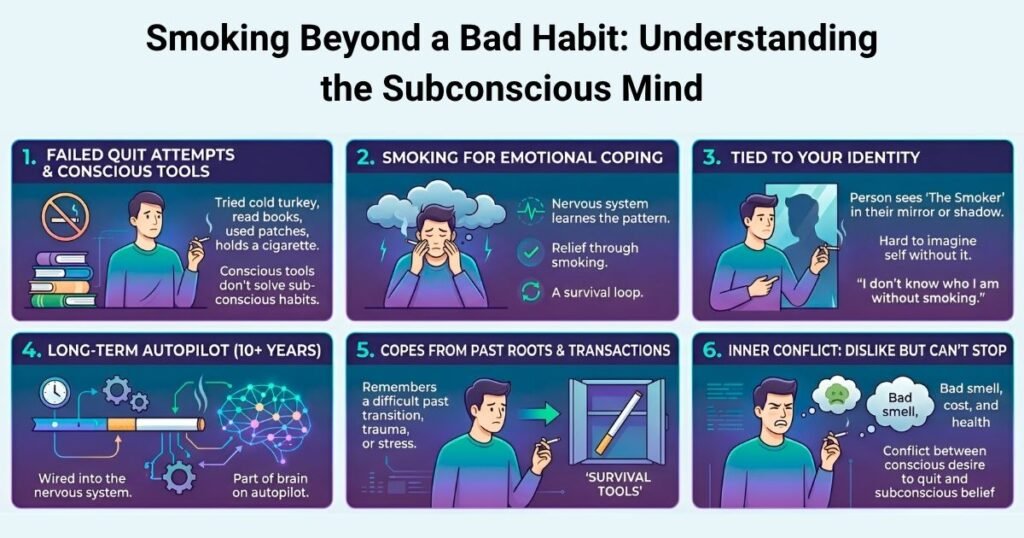
Here are the signs:
Sign #1: You’ve Tried to Quit Multiple Times, and It Didn’t Stick
If you’ve read the books, tried cold turkey, used nicotine replacement therapy, and you’re still smoking, that’s a sign.
Write down how long the attempt lasted and what changed right before you smoked again. If nicotine withdrawal symptoms were the hardest part, tell your clinician what nicotine replacement you used and how you used it. That detail is more useful than saying the patch didn’t work.
Sign #2: You Smoke When You’re Stressed, Anxious, or Overwhelmed
If a cigarette is your quickest excuse to step away, the break itself may be part of what you miss.
Your nervous system has learned: stress = cigarette = relief.
That’s not a thought-driven habit. That’s a survival pattern.
Sign #3: You Can’t Imagine Who You’d Be Without Cigarettes
If quitting feels like losing part of yourself, ask which part you actually want to keep: time with friends, a few minutes alone, or the chance to step outside at work.
Your identity is tied to smoking. And identity lives in the subconscious.
Sign #4: You’ve Been Smoking for 10+ Years
The longer you’ve been smoking, the more likely it’s subconscious.
Because over time, smoking gets wired into your nervous system. It becomes part of how your brain operates on autopilot.
Sign #5: Smoking Started as a Coping Mechanism
Did you start smoking during a stressful period in your life? After a trauma? During a difficult transition?
If smoking was how you coped with something overwhelming, your brain filed it under “survival tools.”
And your nervous system doesn’t let go of survival tools easily.
Sign #6: You Smoke Even Though You Hate It
You can dislike the smell, cost, and health effects of smoking and still struggle to stop.
Because your conscious mind wants to quit, but your subconscious mind believes you need it.
How to Make a Plan to Quit Tobacco With Professional Help
If you use tobacco products such as cigarettes or smokeless tobacco, or are vaping as well as smoking, tell your provider. They can help you quit with a personalized quit plan. Before you set a quit date, ask how nicotine replacement therapies work and what to do if symptoms get in the way. Options such as a nicotine patch or nicotine gum may help with withdrawal. A quit coach can also help you plan for a situation where you usually smoke.
Why Information Alone Can’t Fix a Subconscious Problem
Here’s the thing about books, apps, and videos:
They give you information. They help you understand smoking intellectually.
And for some people, that’s enough.
But if your smoking is subconscious, understanding it intellectually doesn’t resolve it.
Let me give you an analogy:
Imagine you’re terrified of flying. Someone gives you statistics showing that flying is safer than driving. They explain how planes work. They show you videos of pilots explaining the safety features.
Does that make the fear go away?
Probably not. Because the fear doesn’t live in your conscious, logical mind. It lives in your nervous system.
You can understand that flying is safe and still be terrified.
Smoking is the same way.
You can understand that cigarettes aren’t actually helping you. You can know intellectually that you don’t need them. You can read all the reasons why quitting is good for you.
Information can explain why you want to stop smoking. It doesn’t teach you what to do during the argument, work break, or sleepless night when you’re most likely to reach for a cigarette.
Because you’re trying to solve a subconscious problem with conscious tools.
And that’s not a character flaw. That’s just a mismatch of methods.
What Professional Support Actually Does (That Books and Apps Can’t)
So what does professional support do differently?
Professional support can help in two practical ways. Counseling helps you plan for triggers and make changes you can repeat. A clinician can also discuss medicines to manage nicotine cravings. The CDC’s clinical guidance says combining counseling and medication can more than double the chances of quitting.
When you work with a hypnotherapist (or other professional who specializes in subconscious work), you’re not getting more information about smoking.
Hypnotherapy is a separate option some people explore for the habit side of smoking cessation. A Cochrane review of 14 studies and 1,926 participants found insufficient evidence that it worked better than other behavioral support. If it interests you, ask how it would fit alongside, rather than delay, treatments with stronger evidence.
Here’s what that looks like:
Step 1: Identify the Subconscious Root
We don’t just talk about smoking as a habit. We explore:
- When did smoking start?
- What was happening in your life at that time?
- What need was smoking meeting?
- What does your nervous system believe smoking is protecting?
This isn’t surface-level conversation. This is deep subconscious exploration.
Step 2: Access the Subconscious Mind
During hypnotherapy, you may use focused attention and guided suggestions to rehearse a different response to an urge.
This is where the automatic patterns live. This is where the protective mechanisms are stored.
The exercise gives you a chance to practice that response; it doesn’t guarantee that the next urge will disappear.
Step 3: Practice a Different Response
Take a situation that tends to catch you out and walk through exactly what you can do differently.
We don’t just cover it up with willpower. We don’t just distract you from it.
Make the alternative specific enough that you can remember it under pressure.
We update your subconscious belief system:
- Cigarettes ≠ safety
- Cigarettes ≠ stress relief
- Cigarettes ≠ who you are
A craving can still show up. The aim is to have a response ready before you have to decide what to do.
Step 4: Change the Routine Around a Trigger
We also work on rewiring the automatic triggers.
Coffee → cigarette becomes coffee → just coffee.
Stress → cigarette becomes stress → deep breath, new coping tool.
Break → cigarette becomes break → actual rest without needing to smoke.
For example, if you always smoke in the car after work, try putting water in the cup holder, taking a different route past the store where you buy cigarettes, and asking a friend to call when you get home. The cue is familiar; your next move is different.
Step 5: Shift the Identity
This is the most powerful part.
We work with your subconscious to shift your identity from “smoker” to “non-smoker.”
Not as a conscious affirmation you have to repeat. But as a deep, subconscious knowing.
And once your identity shifts, everything changes. Because you’re not resisting cigarettes anymore. You simply don’t identify with them.
What Can Help You Stay Smoke-Free?
Set a time to check in after your quit day. Bring what you’ve noticed about cigarette smoking triggers. Counseling and medication can increase your chances of quitting. If you are trying to quit smoking or vaping, you can also ask which options apply to your tobacco use.
When to Get Professional Help to Quit Smoking
So how do you know if you need professional support?
Ask yourself these questions:
Question 1: Have I Tried DIY Methods and They Didn’t Work?
If you’ve read the books, tried cold turkey, used apps, and you’re still smoking, that’s a sign you need a different approach.
Question 2: Have I Been Smoking for More Than 10 Years?
Years of smoking can mean years of repeating the same routines. That’s useful information when you decide where your quit plan needs extra support.
Question 3: Do I Use Smoking to Cope With Stress, Anxiety, or Emotions?
If cigarettes have been your main way of getting through stress, talk through what else is available during a difficult day.
Question 4: Does the Idea of Quitting Feel Scary or Impossible?
If quitting feels like losing part of yourself, or if you genuinely can’t imagine life without cigarettes, your smoking is tied to identity. That’s subconscious work.
Question 5: Do I Hate Smoking but Still Can’t Stop?
If your conscious mind wants to quit but you keep smoking anyway, that’s the clearest sign that your smoking is subconscious.
Question 6: Am I Tired of Trying and Failing?
If you’re exhausted from quit attempts that don’t stick, you need a method that actually addresses the root cause.
If several of these questions feel familiar, you have enough reason to ask for help now.
In the US, you can call 1‑800‑QUIT‑NOW for free quitline coaching. Bring a recent example: “I bought a pack after my shift.” A coach can help turn that detail into a plan for tomorrow.
What Happens When You Address Smoking at the Subconscious Level
Here’s what happens when you work with a professional who addresses smoking at the subconscious level:
Cravings Can Become Easier to Manage
You’re not white-knuckling it. You’re not resisting cravings every day.
With practice and support, the urge can become easier to ride out, even when it doesn’t go away immediately.
You Don’t Feel Deprived
You’re not giving up something you want. You genuinely don’t want it anymore.
That’s the difference between willpower-based quitting and subconscious resolution.
Triggers Stop Pulling You
Coffee, stress, and social situations may still bring up the thought of smoking. Over time you can build other ways to get through those moments.
Because the automatic associations have been rewired at the subconscious level.
You Feel Like Yourself Again
You’re not fighting yourself. You’re not managing two identities.
You’re just one person. A non-smoker.
How Long Does Quitting Take?
There is no reliable number of sessions that can tell you when you’ll quit for good.
Track changes you can actually observe, such as smoke-free days, which situations felt easier, and whether you recovered sooner after a slip.
If a plan isn’t helping, bring those notes to a follow-up. You and your clinician can make adjustments instead of restarting from scratch.
You’re Not Broken; You’ve Just Been Using the Wrong Tools
If you’ve tried everything and you’re still smoking, I want you to hear this clearly:
You’re not broken. You’re not weak. You’re not lacking willpower.
You’ve just been trying to solve a subconscious problem with conscious tools.
And that’s not your fault.
If DIY tools haven’t helped you stay smoke-free, that tells you where to add support. It doesn’t tell you anything about your character.
You might need help with tobacco dependence, a better plan for a specific routine, or both.
That’s not a failure on your part. That’s just how the brain works.
When to Choose DIY vs. When to Get Professional Help
Here’s a simple framework:
Choose DIY Methods If:
- You’re a casual or social smoker
- You can go days without smoking and not think about it
- You’ve never used smoking to cope with stress or trauma
- Smoking isn’t tied to your identity
- You haven’t tried to quit before (or you’ve only tried once)
Self-guided options include a quit-smoking app, a trigger diary, or asking a friend to check in on the day you’ve chosen to quit.
Get Professional Help If:
- You’ve tried DIY methods and they didn’t work
- You’ve been smoking for 10+ years
- You use smoking to manage stress, anxiety, or emotions
- Smoking is tied to your identity
- You’ve tried to quit multiple times and it didn’t stick
- You feel like you can’t imagine life without cigarettes
Options for professional support include primary care, quitline counseling, and a tobacco cessation program that can help you weigh medication and behavioral support.
You Deserve Support That Actually Works
If you’ve been struggling to quit on your own, it’s not because you’re not trying hard enough.
It’s because you’ve been using tools that weren’t designed for your type of smoking.
And that’s okay. Now you know.
You don’t have to keep fighting the same battle over and over.
If you are ready to quit, start with one useful conversation: what happened last time, what helped even briefly, and what support can you put in place before your next quit date?
And when you do that, quitting stops being a battle. It becomes a shift.
A shift in identity. A shift in how your nervous system responds to stress. A shift in who you believe you are.
Progress can look like getting through a difficult moment without a cigarette, even if the rest of the week is messy.
Because it’s not about forcing yourself to stop. It’s about becoming someone who simply doesn’t smoke anymore.
Ready to quit without the struggle? Book a free Clarity Call.
