I spent years telling myself I’d quit “next week.” Or after the holidays. Or once work settled down. I thought if I could just be stronger or more disciplined, I’d finally break the habit.
But every time life got stressful, the same thought would pop up: “Just one.”
And “just one” always became a week. Then a month. Then the cycle started again.
If you’re stuck in that same loop—quitting and relapsing, over and over—I want you to know something important: it’s not your fault. You’re not lacking willpower. You’re not weak. You’ve just been fighting the wrong battle.
Here’s what finally shifted everything for me: realizing that smoking wasn’t my problem. It was my solution.
Table of Contents
Why You Keep Going Back to Cigarettes (Even When You Hate Them)
Let me ask you something: do you actually enjoy smoking anymore?
Most long-term smokers don’t. They don’t love the taste. They don’t love the smell. They don’t love how it makes them feel about themselves. They don’t love spending the money or standing outside in the cold or worrying about their health.
So why do they keep doing it?
Because smoking isn’t about enjoyment. It’s about function.
Cigarettes do something for you. They meet a need. And until you figure out what that need is—and find a healthier way to meet it—you’ll keep going back, no matter how many times you “quit.”
For me, smoking was how I managed my emotions. It was how I calmed myself when I felt anxious. How I reset my nerves after a hard conversation. How I stepped away when life felt loud. How I coped with stress I didn’t know how to process any other way.
I wasn’t addicted to cigarettes. I was addicted to the relief they gave me.
And here’s the thing: your conscious mind knows cigarettes aren’t actually solving anything. But your subconscious mind—the part that runs your automatic behaviors—believes they are. Because every time you’ve felt stressed and then smoked a cigarette, your brain recorded that as a success. Problem solved.
That’s why willpower doesn’t work. You’re trying to use logic and discipline to override a deeply ingrained survival pattern. Your subconscious genuinely believes cigarettes are keeping you safe.
What Smoking Was Really Doing for You
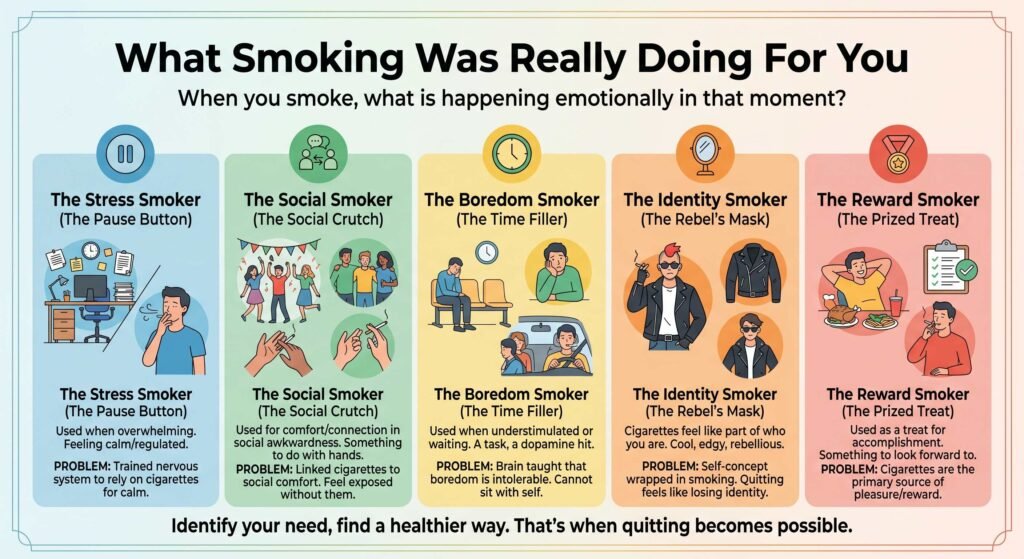
Let’s get specific. When you smoke, what is happening emotionally in that moment?
Most smokers fall into one of these categories:
The Stress Smoker
You smoke when things feel overwhelming. Work is chaotic, life is demanding, and a cigarette is the only thing that makes you feel like you can breathe again. Smoking gives you a pause button. It’s five minutes where no one can ask you for anything.
The problem: you’ve trained your nervous system to rely on cigarettes for regulation. You don’t know how to calm yourself down without them.
The Social Smoker
You smoke when you’re out with friends, at parties, or in social situations where you feel awkward or anxious. Smoking gives you something to do with your hands. It gives you a reason to step outside. It connects you with other smokers. It makes you feel less self-conscious.
The problem: you’ve linked cigarettes to social comfort. Without them, you feel exposed or out of place.
The Boredom Smoker
You smoke when you’re understimulated—waiting for something, sitting in traffic, killing time. Cigarettes fill the empty moments. They give you a task, a small hit of dopamine, something to focus on when there’s nothing else happening.
The problem: you’ve taught your brain that boredom is intolerable and cigarettes are the solution. You’ve lost the ability to just sit with yourself.
The Identity Smoker
You’ve been a smoker for so long that it feels like part of who you are. Maybe you identify as a rebel, or someone who doesn’t follow the rules. Maybe smoking makes you feel cool, or edgy, or like you’re part of a certain group. The idea of not smoking feels like losing a piece of yourself.
The problem: your self-concept is wrapped up in smoking. Quitting feels like losing your identity, not just a habit.
The Reward Smoker
You smoke after accomplishing something—finishing a meal, completing a task, getting through a hard day. It’s your treat, your reward, the thing you look forward to. Without it, you feel like you’re being deprived.
The problem: you’ve made cigarettes your primary source of pleasure and reward. Life without them feels joyless.
Which one are you? Maybe you’re a combination of several.
The point is this: once you identify what cigarettes have been doing for you, you can start finding healthier ways to meet those needs. And that’s when quitting becomes possible.
Why Trying to Quit with Willpower Keeps Failing You
Every time you try to quit with willpower alone, you’re setting yourself up for a battle you’re going to lose.
Here’s why:
Willpower is a finite resource. It works in the short term—you can force yourself not to smoke for a few hours, maybe even a few days. But willpower depletes. When you’re tired, stressed, emotional, or triggered, your willpower tanks. And that’s when your subconscious takes over and runs the old program: “Stress = cigarette.”
You light up. And then you beat yourself up for “failing.” You tell yourself you’re weak, that you don’t have enough discipline, that you’re never going to be able to quit.
But the truth is, you didn’t fail because you’re weak. You failed because you were using the wrong tool.
It’s like trying to cut down a tree with a butter knife. It’s not that you’re not trying hard enough—it’s that the tool doesn’t match the task.
What Finally Helped Me Quit (And Why Hypnotherapy Works)
When I discovered hypnotherapy, everything changed.
For the first time, I wasn’t trying to force myself to stop smoking. I was addressing why I started in the first place. I was working with my subconscious mind instead of fighting against it.
Hypnotherapy allowed me to:
Understand What Smoking Was Doing for Me
We identified the emotional needs smoking was meeting. For me, it was stress relief and a way to create boundaries—to step away from people and responsibilities and just have a moment to myself.
Once I understood that, I could address it directly. I didn’t need to stop smoking through sheer force. I needed to find healthier ways to manage stress and create space for myself.
Rewire My Automatic Responses
Through hypnotherapy, we reprogrammed my subconscious associations. My brain learned: “You don’t need a cigarette to feel calm. You can take a deep breath. You can step outside without smoking. You can feel stressed and still be okay.”
Those associations shifted at the subconscious level, which meant I didn’t have to consciously remind myself every time I felt triggered. My brain just automatically responded differently.
Change My Identity
This was the biggest shift. I stopped seeing myself as “a smoker trying to quit” and started seeing myself as a non-smoker. That wasn’t something I forced or faked—it was a genuine shift that happened through the hypnotherapy process.
When you identify as a non-smoker, cigarettes stop feeling like something you want but can’t have. They feel irrelevant. You walk past someone smoking and it doesn’t appeal to you. That’s when you know the change is real.
Release the Guilt and Shame
So much of smoking is wrapped up in shame. You feel bad about yourself for not being able to quit. You hide it from people. You judge yourself for being “weak.”
Hypnotherapy helped me let go of that narrative. I wasn’t weak. I was human. I had learned a coping mechanism that worked for a long time, and now I was learning a better one. There was nothing to be ashamed of.
Once I released the shame, the whole process became easier. I wasn’t fighting against myself anymore. I was working with myself.
What It Feels Like to Quit Smoking the Right Way
When you quit smoking by addressing the root cause—the emotional need, the subconscious programming, the identity—it feels completely different from white-knuckling it.
Here’s what my clients describe:
- “I don’t feel like I’m missing out on anything. I just genuinely don’t want to smoke.”
- “I was around smokers all night and it didn’t even cross my mind to have one.”
- “I had my morning coffee and didn’t think about cigarettes once. That’s never happened before.”
- “I feel like I finally have control over my own mind.”
That’s the difference between forcing yourself to quit and actually rewiring the habit at its source.
You’re not depriving yourself. You’re freeing yourself.
If You’re Stuck in the Quit-Relapse Cycle, This Is for You
If you’ve tried to quit before and it didn’t stick, I want you to hear this: the version of you who tried so many times before wasn’t failing. You were just missing a piece of the puzzle.
You don’t need more willpower. You don’t need more discipline. You need to work at the level where the habit actually lives—in your subconscious mind, in your emotional patterns, in the identity you’ve built around smoking.
Once you do that, everything shifts. The cravings fade. The triggers lose their power. And the part of you that always wanted to quit finally gets to win.
Now, as a hypnotherapist, I help clients uncover the same thing: what smoking has been doing for them emotionally. Because once you address the real need underneath the habit, the cigarettes lose their power.
You’ve been fighting long enough. It’s time to fight smarter, not harder.
FAQ: When You’ve Tried Everything
What if nothing has worked for me before?
That has nothing to do with your ability to quit. It only means the root cause hasn’t been addressed yet.
Do you work with heavy smokers?
Yes. Pack-a-day, multi-pack, 20–40+ years — the subconscious pattern is the same.
Will I still get cravings?
Most clients notice cravings disappear or feel extremely mild because the emotional driver is gone.
What if I’m scared to fail again?
That fear is normal — and it goes away fast when your subconscious updates its programming.
How long does it take?
Most people quit in 1–2 sessions. Reinforcement sessions are available if needed.
If You’re Done Starting Over… This Is Your Moment
You’ve carried this habit long enough.
You’ve blamed yourself long enough.
You’ve fought long enough.
And none of it was your fault.
If you’re ready for quitting to finally feel easy, book a free Clarity Call.
