
Do you have a backup plan for when you quit smoking?
Most people do.
They buy nicotine gum. They download a quit-smoking app. They keep a vape device nearby “just in case.” They stock up on snacks, stress balls, or breathing exercises.
They build an entire system around one simple assumption:
When cravings hit, I’ll need something to help me resist.
And I understand why. Because most quit-smoking methods teach you to prepare for battle.
They tell you: “Cravings are inevitable. Here’s how to manage them.”
So you arm yourself with tools. You create a backup plan. You get ready to fight.
But here’s what I want you to consider:
What if you never needed a backup plan at all?
What if the presence of a backup plan is actually revealing something important about your approach—and keeping you stuck in a cycle of management instead of transformation?
Let me explain.
Why Most People Create Backup Plans for Quitting Smoking
When you decide to quit, the first question everyone asks is:
“What are you going to do when you get a craving?”
Not if you get a craving. When.
The assumption is baked in from the start: cravings are inevitable. You will want to smoke. The question is just how you’ll cope with that want.
So you prepare:
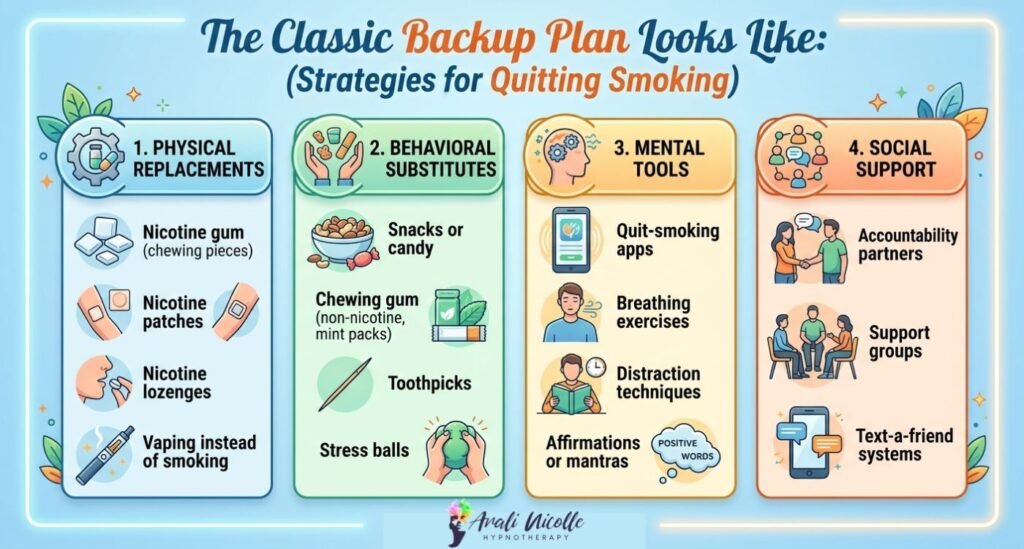
The Classic Backup Plan Looks Like:
Physical replacements:
- Nicotine gum
- Nicotine patches
- Nicotine lozenges
- Vaping instead of smoking
Behavioral substitutes:
- Snacks or candy
- Chewing gum (non-nicotine)
- Toothpicks
- Stress balls
Mental tools:
- Quit-smoking apps
- Breathing exercises
- Distraction techniques
- Affirmations or mantras
Social support:
- Accountability partners
- Support groups
- Text-a-friend systems
All of these serve one purpose: to help you manage the urge when it shows up.
And on the surface, this seems smart. You’re being prepared. You’re not going into this blindly.
But here’s the problem:
Your backup plan is built on the assumption that you’ll always want to smoke.
And that assumption becomes your reality.
What Your Backup Plan Actually Reveals (And Why It Keeps You Stuck)
Let me show you what your backup plan is actually saying:
“I’m expecting to struggle.”
When you create a backup plan, you’re planning for war.
You’re saying: “This is going to be hard. I’m going to want to smoke. And I need tools to survive the battle.”
That expectation creates the experience.
“I don’t actually believe I can become someone who doesn’t want cigarettes.”
If you truly believed you could become a non-smoker—someone who simply doesn’t want to smoke—you wouldn’t need a backup plan.
You don’t have a backup plan for not wanting coffee when you’re not a coffee drinker.
You don’t have a backup plan for not craving something you genuinely have no interest in.
The backup plan reveals: “I still believe I’ll want cigarettes. I’m just preparing to resist that want.”
“I’m focusing on management, not transformation.”
A backup plan is designed to help you manage the urge to smoke.
But management assumes the urge will always exist.
And when you assume the urge will always exist, you’re not working toward transformation. You’re working toward better coping.
Those are two completely different goals.
The Assumption Behind Every Backup Plan: “I’ll Always Want to Smoke”
Here’s the core issue:
Every backup plan is built on one belief: the desire for cigarettes is permanent.
Think about it.
Why would you need nicotine gum if you didn’t expect to crave cigarettes?
Why would you need a distraction technique if you didn’t expect the urge to show up?
Why would you need an accountability partner if you didn’t expect to be tempted?
The presence of a backup plan assumes ongoing desire.
And here’s what most people don’t realize:
When you expect the desire, you reinforce it.
Your brain is incredibly good at creating what you expect. If you’re preparing for cravings, your brain will generate them—because that’s what you’ve told it to anticipate.
The Self-Fulfilling Prophecy
- You assume you’ll crave cigarettes
- You create a backup plan to manage cravings
- Your brain generates cravings (because that’s what you expected)
- You use your backup plan
- The backup plan “works” (you didn’t smoke)
- This confirms your belief: “I need a backup plan. Cravings are inevitable.”
The cycle repeats.
And you stay stuck in management mode—forever preparing for the next craving, forever resisting the urge.
Management vs. Transformation: Two Completely Different Approaches
Let me show you the fundamental difference:
The Management Approach (Backup Plan Required)
Assumption: You will always want to smoke
Goal: Learn to cope with the urge
Method: Use tools (gum, apps, distraction) to resist when cravings hit
Experience: Constant battle. Daily resistance. Preparing for war.
Mindset: “I’m a smoker who’s trying not to smoke”
Backup plan: Essential. You expect cravings, so you need tools to manage them.
Outcome: You don’t smoke, but you still want to. The desire never fully goes away.
The Transformation Approach (No Backup Plan Needed)
Assumption: The desire to smoke can be eliminated
Goal: Become someone who doesn’t want to smoke
Method: Resolve the subconscious pattern that creates cravings
Experience: Natural disinterest. No fight. No resistance.
Mindset: “I’m a non-smoker”
Backup plan: Not needed. The craving doesn’t show up, so there’s nothing to manage.
Outcome: You don’t smoke, and you don’t want to. The desire is gone.
One keeps you in a perpetual battle. The other sets you free.
Why Backup Plans Reinforce the Battle (Instead of Ending It)
Here’s what happens when you rely on backup plans:
You’re Always Preparing for the Next Craving
Every day, you wake up knowing you’ll have to resist the urge at some point.
You plan your day around it. You keep your gum handy. You have your app ready. You’re braced for the fight.
That’s not freedom. That’s vigilance.
You’re Constantly Aware of Smoking
Even though you’re not smoking, cigarettes are always on your mind.
You’re thinking about them when you reach for gum. When you use your app. When you employ your distraction technique.
You’re not free from smoking. You’re managing it.
You Never Fully Trust Yourself
As long as you need a backup plan, you don’t fully trust that you’ve changed.
You’re still seeing yourself as someone who might want to smoke—and you need tools to protect you from that want.
The backup plan keeps you in the identity of “person who wants to smoke but is resisting.”
The Craving Becomes a Self-Fulfilling Expectation
Because you’re expecting cravings, your brain generates them.
Not because they’re inevitable. But because your expectation creates the reality.
And every time you use your backup plan, you reinforce the cycle.
What Happens When You Don’t Need a Backup Plan
So what does it look like when you truly don’t need a backup plan?
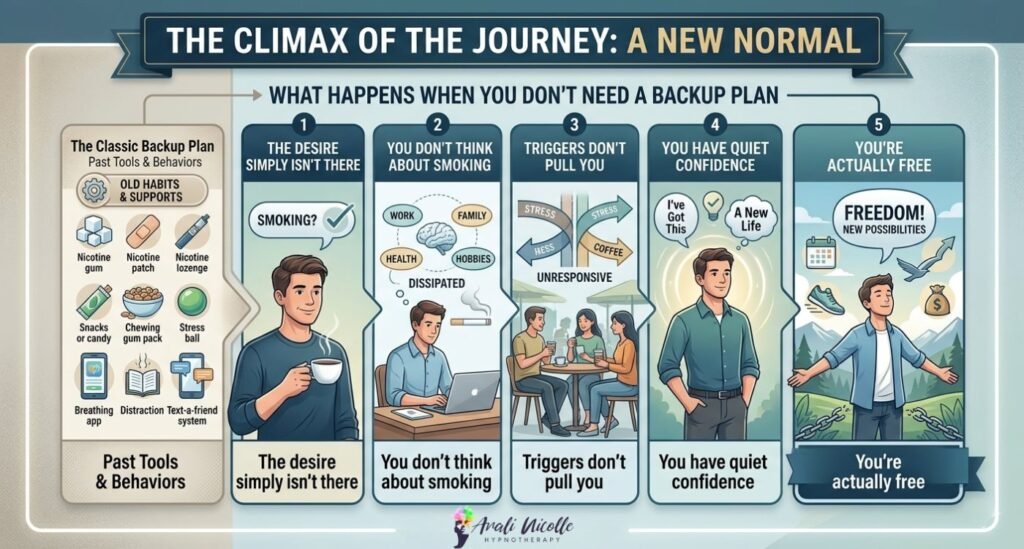
The Desire Simply Isn’t There
You’re not resisting cigarettes. You’re not managing urges. You’re not white-knuckling through triggers.
The craving just… doesn’t show up.
It’s not that you’re getting better at ignoring it. It’s that your brain has stopped generating it.
You Don’t Think About Smoking
You go days, weeks, months without thinking about cigarettes.
Not because you’re avoiding the thought. But because it genuinely doesn’t cross your mind.
The way a non-smoker doesn’t think about smoking.
Triggers Don’t Pull You
You can have coffee. You can feel stressed. You can be in situations where you used to smoke.
And nothing happens. No craving. No internal battle.
Because the subconscious association has been resolved.
You Have Quiet Confidence
You’re not constantly checking in with yourself: “Am I okay? Do I want a cigarette?”
You just know you’re done.
There’s a calm certainty. A quiet confidence.
You’re not someone trying not to smoke. You’re someone who simply doesn’t smoke.
You’re Actually Free
This is what true freedom feels like.
No backup plans. No tools. No management systems.
Just the natural ease of not wanting something you used to want.
How to Quit Smoking Without Preparing for War
So how do you get to a place where you don’t need a backup plan?
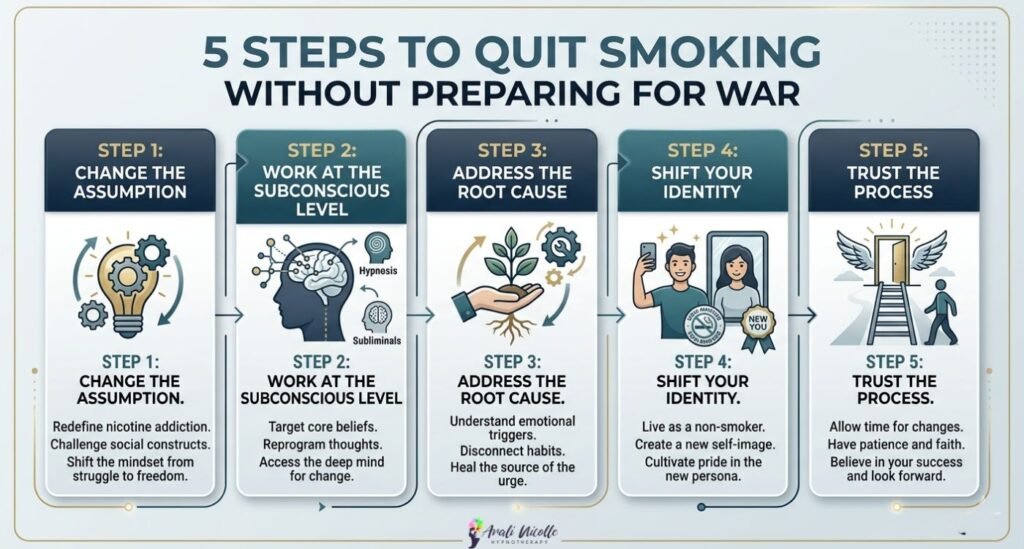
Step 1: Change the Assumption
Stop assuming cravings are inevitable.
Start asking: “What if the desire to smoke could disappear entirely?”
That shift in assumption changes everything.
Step 2: Work at the Subconscious Level
Cravings are generated by subconscious patterns your brain learned years ago.
If you want to eliminate cravings (not just manage them), you need to work at the level where they’re created.
That’s what hypnotherapy does.
We don’t teach you to resist cravings. We resolve the subconscious pattern that generates them.
Step 3: Address the Root Cause
Your brain is generating cravings for a reason.
At some point, it decided smoking solved something—stress relief, emotional regulation, a break, control, identity.
Until that root cause is addressed, cravings will keep showing up.
But when you resolve what smoking was protecting, the brain stops reaching for cigarettes as a solution.
Step 4: Shift Your Identity
As long as you see yourself as “a smoker who’s trying to quit,” you’re in resistance mode.
But when your identity shifts to “non-smoker,” everything changes.
You’re not fighting anymore. You’re just being who you are.
Step 5: Trust the Process
Here’s the hardest part for most people:
Letting go of the backup plan feels scary.
Because you’ve been conditioned to believe you need it.
But the backup plan is keeping you stuck in the identity of “someone who might crave cigarettes.”
Real transformation means trusting that you don’t need it.
The Backup Plan Test: A Question to Ask Yourself
Here’s a powerful question:
If you truly believed you would never want to smoke again, would you still create a backup plan?
Think about it.
If you genuinely knew—deep in your bones—that the desire was gone, that you would never crave a cigarette, that you were completely free…
Would you buy nicotine gum?
Would you download a quit-smoking app?
Would you keep a vape device “just in case”?
No. You wouldn’t.
Because there would be nothing to prepare for.
The presence of a backup plan reveals that you don’t fully believe you can be free from wanting to smoke.
And that belief—that expectation—is what keeps the desire alive.
Real Transformation Means Never Needing One
Here’s what I want you to understand:
A backup plan isn’t a sign of preparation. It’s a sign of expectation.
You’re expecting to want cigarettes. So you’re preparing to manage that want.
But what if you could eliminate the want itself?
What if you could resolve the subconscious pattern that creates cravings—so the desire simply stops being generated?
What if you could become someone who doesn’t need a backup plan because there’s nothing to back up against?
That’s real transformation.
Not managing. Not coping. Not preparing for battle.
Just the quiet confidence of knowing you’re done.
And when you experience that—when you realize you genuinely don’t want to smoke anymore—you’ll understand:
Backup plans were never about being prepared. They were about staying stuck in the identity of someone who wants to smoke but is resisting.
True freedom means never needing one.
Ready to quit without the struggle? Book a free Clarity Call.
