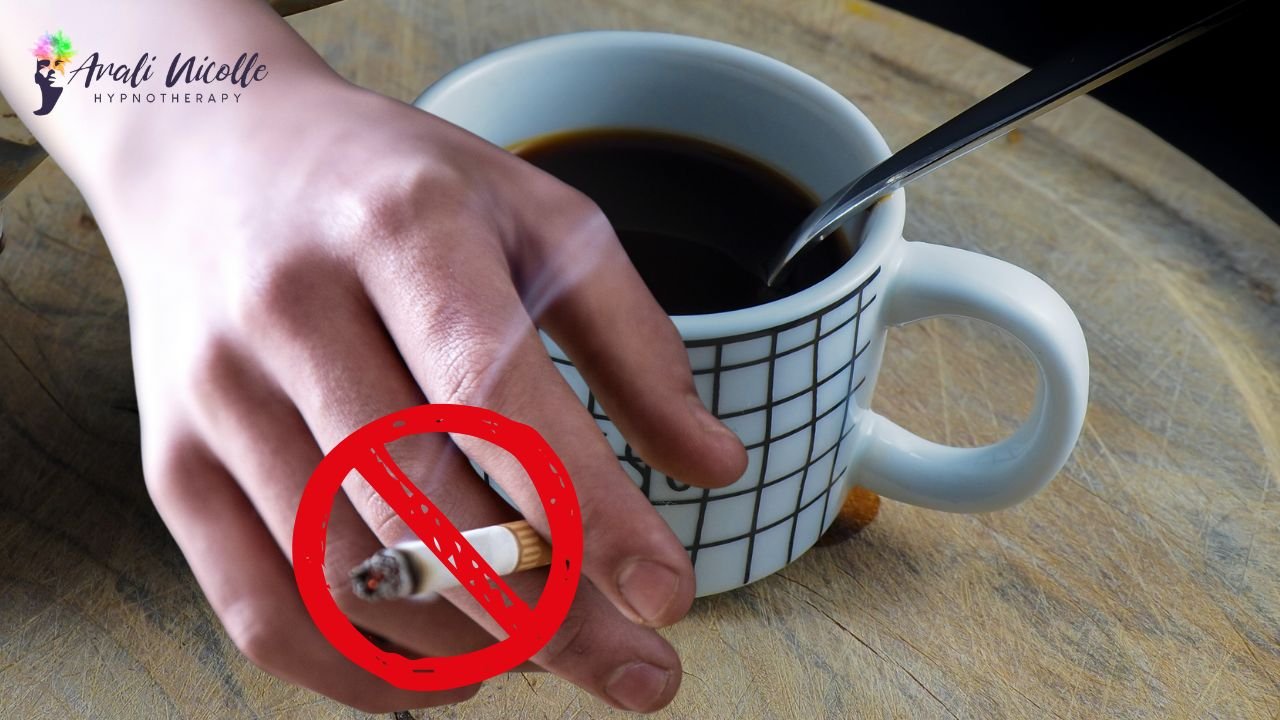
If you’ve ever wondered why certain moments make you want to smoke more than others, you’re not imagining it. There’s a reason your brain links cigarettes to coffee, driving, drinking, stress at work, or even boredom. These aren’t random triggers. They’re conditioned associations your mind has built over years.
Let me explain it the way I wish someone had explained it to me when I smoked.
Your subconscious mind loves pairing experiences together. If you’ve smoked while drinking your morning coffee enough times, your brain starts to believe the two go together. It’s like they become one memory. So when you decide you’re going to quit, the coffee itself can trigger a craving—because your mind assumes a cigarette should follow.
This is why quitting often feels harder in certain situations. You’re not craving nicotine. You’re craving the pattern your brain expects.
How Your Brain Creates Smoking Triggers
Let me walk you through how this works on a neurological level—but I promise I’ll keep it simple.
Every time you perform a behavior, your brain creates a pathway. Think of it like walking through a field of tall grass. The first time you walk through, you’re forging a new path. It takes effort. But if you walk that same route every single day for months or years, eventually you create a clear, worn trail. That’s what happens in your brain with repeated behaviors.
When you smoke a cigarette while drinking coffee, your brain releases dopamine—a feel-good chemical. It doesn’t just associate the dopamine with the nicotine. It associates it with the entire experience: the coffee, the warmth of the mug, the time of day, the location, even the people you’re with.
Over time, your brain learns: “Coffee = cigarette = dopamine = good.”
Now coffee isn’t just coffee anymore. It’s the first half of a two-part ritual. And when you try to quit, your brain is confused. It’s like showing up to a concert and the opening act never comes out. Something feels incomplete.
This is called classical conditioning, the same process that made Pavlov’s dogs salivate at the sound of a bell. Your brain has been conditioned to expect a cigarette in certain contexts, and when it doesn’t get one, it sends you a craving signal.
The Most Common Smoking Triggers (And Why They’re So Powerful)
Different people have different triggers, but certain patterns show up again and again. Here are the most common smoking triggers I see with clients:
Coffee and Cigarettes
This is the big one. For so many smokers, coffee and cigarettes are inseparable. Why? Because caffeine is a stimulant, and nicotine is also a stimulant. Together, they create a specific feeling—alert, focused, energized. Your brain has learned to associate that feeling with having both substances at once.
When you quit smoking but keep drinking coffee, your brain is expecting the second half of the equation. The coffee alone doesn’t produce the same effect, so your mind interprets that as something being missing.
Alcohol and Smoking
Alcohol lowers inhibitions. It also impacts the prefrontal cortex—the part of your brain responsible for decision-making and self-control. This is why people who haven’t smoked in weeks will suddenly find themselves bumming a cigarette at a bar.
But there’s another layer to it: social conditioning. If you’ve spent years smoking while drinking, your brain has linked the two experiences. A drink in your hand becomes a trigger, just like coffee.
Stress and Cigarettes
This is the most emotionally loaded trigger. When you’re stressed, your body goes into fight-or-flight mode. Your heart rate increases, your breathing gets shallow, cortisol spikes. A cigarette—counterintuitively—feels calming.
Here’s why: when you smoke, you take a deep inhale. You pause. You exhale slowly. That physical act of deep breathing actually does calm your nervous system. But your brain credits the cigarette, not the breathing.
Over time, your mind learns: “Stress = cigarette = calm.” So when you quit, your brain doesn’t know how to downregulate stress anymore. It only knows one solution, and you’ve taken it away.
Boredom and Smoking
Cigarettes give you something to do. They fill empty moments. If you’re someone who smokes when you’re bored, your brain has learned to use cigarettes as a way to create stimulation when there’s nothing else happening.
This is especially hard to break because boredom is everywhere. Waiting in line, sitting in traffic, scrolling on your phone—these are all moments where your brain used to default to smoking.
After Meals
Smoking after eating is another deeply ingrained pattern. There’s even a physiological component: nicotine can increase metabolism and suppress appetite, so your brain has learned to “complete” a meal with a cigarette.
But the bigger factor is ritual. For many smokers, the cigarette after a meal is the reward. It’s the punctuation mark at the end of the experience. Without it, the meal feels unfinished.
Why Pattern-Based Cravings Feel Worse Than Nicotine Cravings
Here’s something that surprises a lot of people: nicotine withdrawal is actually pretty mild. The physical symptoms peak around 48-72 hours after your last cigarette, and they’re manageable—irritability, headache, restlessness. Most people can push through that.
But pattern-based cravings? Those can last for months. Because they’re not about nicotine. They’re about context.
You can be completely nicotine-free and still get hit with a powerful craving when you’re in a situation where you used to smoke. That’s your brain recognizing the context and expecting the behavior that usually follows.
This is why so many people relapse weeks or even months after quitting. They think they’re “over it,” and then they’re at a wedding, or a stressful day at work, or having drinks with friends, and suddenly the craving is back at full force.
They didn’t fail. Their subconscious just recognized a familiar pattern and tried to complete it.
How Hypnotherapy Breaks the Pattern Between Triggers and Cigarettes
Hypnotherapy works so well for smoking because we go right to the place where those patterns are stored. We separate the associations. We tell the mind: “Coffee is just coffee. Stress is just stress. You don’t need a cigarette to get through this moment anymore.”
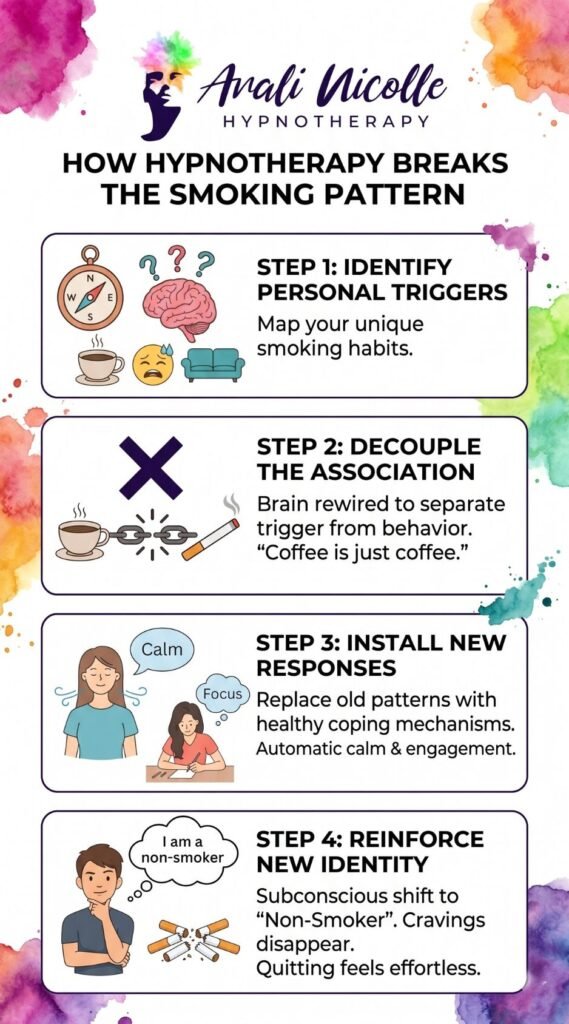
Here’s what that process looks like:
Step 1: Identify Your Specific Triggers
Not everyone has the same triggers. In our sessions, we map out your personal smoking patterns. When do you smoke? What are you doing? How are you feeling? What does the cigarette do for you in that moment?
This isn’t just data collection—it’s awareness. Many people have never consciously examined when and why they smoke. They just do it automatically.
Step 2: Decouple the Association
Once we know your triggers, we use hypnotherapy to rewire the connection between the trigger and the behavior.
For example, if coffee is a trigger for you, we work with your subconscious to separate the two experiences. We create new associations. Coffee becomes a moment of calm, of warmth, of starting your day—without needing a cigarette to complete it.
This isn’t willpower. This is retraining your brain at the level where the habit actually lives.
Step 3: Install New Responses
It’s not enough to just remove the old pattern. Your brain needs something to replace it with.
If you used smoking as a stress reliever, we install new ways to calm your nervous system—deep breathing, grounding techniques, healthier coping mechanisms that your subconscious can default to automatically.
If you smoked when you were bored, we help your brain find new ways to create stimulation and engagement without needing a cigarette.
The goal is to give your subconscious mind new programming—new pathways that are just as automatic as the old ones, but healthier.
Step 4: Reinforce Your New Identity
One of the most powerful parts of hypnotherapy is identity work. When you see yourself as “a smoker trying to quit,” you’re still holding onto the smoker identity. Your mind is still thinking of cigarettes as something you want but can’t have.
But when your subconscious shifts to “I am a non-smoker,” everything changes. You’re not resisting cigarettes anymore. You simply don’t identify with them.
That’s when clients say things like, “I walked past someone smoking and it didn’t even appeal to me,” or “I was at a bar with all my smoking friends and I genuinely didn’t want one.” The identity shift makes quitting feel effortless.
What Happens When Triggers Lose Their Power
When your brain stops linking cigarettes to coffee, stress, alcohol, and boredom, something remarkable happens: you get to enjoy those moments again.
Coffee tastes better. You’re not distracted by a craving. You’re just drinking coffee.
Stress becomes manageable. You learn to sit with discomfort without needing to escape it with a cigarette.
Social situations feel normal. You don’t feel left out or deprived. You just feel present.
That’s when you know your brain has rewired itself. And once you experience that freedom, you’ll never want to go back.
FAQ: Your Most Common Trigger Questions
Why is my morning coffee the hardest part of quitting?
Because your brain fused the ritual into one experience. We break that connection.
Why do I crave cigarettes when I’m bored?
Your brain used cigarettes as stimulation. When the pattern dissolves, the urge disappears.
How long do these pattern cravings last?
Until the subconscious association is rewired. With hypnotherapy, this happens quickly.
Will I always crave cigarettes with alcohol?
No. Once the subconscious identity shifts, the context loses its power.
What if stress is my biggest trigger?
We rebuild your internal stress-regulation system so you no longer rely on cigarettes to calm your nervous system.
Ready to Break the Coffee-Cigarette Loop for Good?
If you’re tired of your triggers running your day — mornings, meals, stress, boredom, nights out — you don’t have to white-knuckle them anymore.
When the subconscious pattern dissolves, triggers stop being triggers.
If you’re ready to drink your coffee as a non-smoker — effortlessly — book a free Clarity Call.
