

Procrastination is something almost everyone wrestles with. You sit down, tell yourself you’ll start in five minutes, and before you know it, an hour has slipped by. It’s frustrating because you’re not avoiding the task out of laziness—you know it needs to get done. But instead, you end up with more stress, guilt, and pressure piling on top. Over time, that cycle doesn’t just waste hours; it slows down careers, health goals, and even personal growth.
Here’s the thing: procrastination usually isn’t about being lazy. It’s about the hidden patterns running in the background of your mind. Fear of failure, perfectionism, or the urge to dodge discomfort—these habits often play on repeat without you even noticing. That’s why willpower alone feels like pushing against a brick wall.
Hypnotherapy for procrastination might involve rehearsing the first minute of a task you’ve been avoiding. There’s less direct evidence for hypnosis than for broader psychological treatments. It’s worth looking at the task itself too. Sometimes you need a missing instruction, ten uninterrupted minutes, or permission to produce a rough draft.
In the next sections, we’ll break down why procrastination happens, how hypnotherapy works, and how it can finally help you break the cycle.
Why Do We Procrastinate Even When a Task Matters?
What Procrastination Really Means
Procrastination shows up in different ways. Sometimes it’s just a minor delay—like putting off dishes or pushing a call to later. But when delays become a habit, tasks start piling up and feel heavier each day. The guilt that follows makes starting even harder, and that cycle quietly drains energy, progress, and opportunities.
Common Psychological and Emotional Triggers
- Fear of failure or judgment: Delaying feels safer than risking a mistake.
- Perfectionism: Wanting everything flawless makes any task feel too big to start.
- Lack of clarity or motivation: Without a clear “why,” even small steps lose direction.
- Avoidance of discomfort: Stress, boredom, or pressure make distractions more appealing than action.
The Subconscious Role in Procrastination
Most of these behaviors run in the background. Habits, past experiences, and old beliefs quietly steer decisions without much thought. That’s why planners and productivity hacks often fall short—you’re trying to solve a surface issue without addressing what’s driving it underneath. Before you call a delay an old pattern, write down what you were trying to do and what happened immediately before you opened another tab. “I didn’t know which figures were current” suggests a different change from “I knew the figures and worried the report would be criticized.”
Stop Procrastination: How to Get Motivated for the First Step
Do you procrastinate on every task or on the ones where you’re unsure what’s expected? A person who wants to overcome procrastination with hypnotherapy can rehearse asking for clarification as easily as opening a document. Notice the difference between a delay that serves a purpose and one that makes the day harder.
How Hypnosis Approaches Procrastination
We’ve all had moments where we know what we should do, but something inside us pulls the brakes. That “something” usually lives in the subconscious—the part of the mind that runs old habits and beliefs on autopilot. Hypnotherapy works by going straight to that level, where real change actually sticks.
The Basics of Hypnotherapy
Forget the stage shows and mind tricks. Clinical hypnotherapy is nothing like that. It’s a guided process that helps you enter a calm, focused state—kind of like zoning out during a long drive or getting lost in a good movie. In that state, your conscious mind takes a step back, and your subconscious becomes easier to work with. You’re still aware, still in control, but far more open to new ideas.
Why the Subconscious Matters
Automatic reactions are one way to describe what happens when a task feels threatening or frustrating. In a review of 12 studies with 718 participants, psychological treatments had a small average benefit for procrastination, and results varied. A smaller subset of CBT studies showed a larger effect. The review did not establish that hypnosis would produce the same results.
Reprogramming Limiting Beliefs
Many procrastination habits come from old scripts, like “I’m not good enough” or “I’ll just mess this up.” Hypnotherapy helps bring those scripts to the surface and replace them with healthier ones such as “I can handle this step by step” or “Progress is better than perfect.” With repetition, these new beliefs start shaping your actions in a more supportive way.
Changing Emotional Responses to Tasks
Often the problem isn’t the task itself—it’s the feeling tied to it. Maybe writing, presenting, or even opening your inbox carries stress. Hypnotherapy helps break that link, turning those stressful triggers into calmer, more neutral experiences. Once the emotion shifts, starting becomes far less of a struggle.
Building a Pathway to Action
Practice starting on a task that matters to you and set an end point you can reach. If the task is “write the report,” open the file and list the decisions the report needs to explain. If you finish in five minutes and still have time, choose whether to continue. The ability to choose can make the next start less daunting.
Can Hypnosis Help With Procrastination?
A hypnosis session for procrastination might use relaxation and hypnotic suggestions to help you pay full attention to the first action. Imagine opening the document, seeing the deadline and typing a rough sentence. If you procrastinate because you still need information from someone, write the question you can ask before you try to power through. Use that distinction when you decide whether to use self-hypnosis or change the task.
What Makes a Hypnotic Suggestion Practical for People Who Procrastinate?
A suggestion may refer to the unconscious mind, but its value is easier to judge in ordinary behaviour. Make it specific: when I pick up my phone in the first five minutes, I’ll put it down and finish this sentence. For people who procrastinate across many settings, treating an underlying psychiatric or attention condition may also be part of care.
How a Hypnosis Session May Help You Stop Procrastinating
An instruction to conquer procrastination may sound motivational, but a hypnosis session can be easier to use if it names the action. If you want to take action on a difficult email, picture typing the opening line. Practise switching back when you get distracted, then check the message against what your reader needs.
How to Stop Procrastination When a Deadline Feels Overwhelming
Picture the first five minutes, including the distraction. That can be more useful than a motivational booster that imagines only an ideal outcome. If you want to stop procrastinating, repeat the shorter task tomorrow and see whether it’s easier to start.
Mental Rehearsal to Stop Procrastination
Hypnotherapy isn’t a one-size-fits-all process. Think of it as a toolbox, with different methods used depending on what’s fueling your procrastination. Some techniques work on how you see a task, others on how you feel when you face it. Together, they help shift you from hesitation into action.
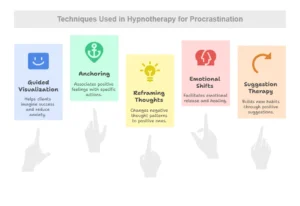 Guided Visualization and Mental Rehearsal
We’ve all imagined a situation so clearly that it felt almost real. Hypnotherapy uses that same principle. By picturing yourself starting and completing tasks successfully, you condition your mind to believe action is possible—and even expected. Just like athletes mentally rehearse before competing, you rehearse productivity until it feels natural. Imagine the less flattering version too. You sit down, feel bored, and write a weak first sentence. Then you stay long enough to write the next one. Some days the useful rehearsal is being willing to start imperfectly, rather than picturing a finished report or waiting for a surge of motivation.
Anchoring and Positive Reinforcement
Anchoring links a small physical action—like touching your thumb and finger—to a mental state of focus or motivation. Once set, repeating the gesture can instantly bring back that state, like flipping a switch. Alongside anchoring, positive reinforcement strengthens the reward cycle in your mind, so finishing even small tasks feels good and builds momentum.
Reframing Negative Thoughts
Procrastination feeds on thoughts like “I’m not ready” or “What if I fail?” In hypnotherapy, those scripts are reworked into supportive ones, such as “I can take this step now” or “Progress is better than perfect.” Changing the internal dialogue reduces resistance and makes starting less intimidating. If a draft feels like a public verdict on your ability, change who sees the first version. Write it for yourself, then decide what to share. You can rehearse that sequence during hypnosis or practice it directly. Splitting the task into drafting and review gives you fewer decisions to make when you first sit down.
Creating Emotional Shifts
Often it’s the feeling tied to a task—not the task itself—that causes avoidance. Hypnotherapy helps reset those emotional triggers so stress, boredom, or dread are replaced with calmer, more neutral feelings. When the emotional weight drops, action feels less like a battle.
Suggestion Therapy for Habit Building
Finally, hypnotherapists use suggestion therapy to plant new habits at a subconscious level. Through repetition, your mind begins to accept ideas like “I start tasks right away” or “I stay focused until I finish.” Over time, these suggestions shape behavior, turning productivity into a natural routine instead of a constant struggle. Choose language specific enough to act on. “When I open my laptop after lunch, I’ll spend five minutes on the first invoice” gives you a moment and a task. If lunch often happens away from your desk, choose a cue that actually happens where you can start.
How to Overcome Procrastination With Hypnotherapy and a Plan
Hypnosis can help you rehearse a single action, such as starting a rough draft before you get distracted. It is a tool for practising that behaviour. It cannot tell you what you ought to do first. During a hypnotherapy session, ask the practitioner to use hypnotic suggestions tied to the task rather than to promise an instant shift in your subconscious mind. If you want to stop procrastinating because a deadline is close, start by making the first step smaller and deciding when it can begin.
Can Hypnosis Help You Take Action When You Get Distracted?
Try using hypnosis to rehearse your response when a message pulls you off the task. A hypnotherapist can help you choose a suggestion that brings back your full attention. Some people call that focused state a trance. When you leave the session, check what happens when a distraction arrives in ordinary life.
What to Look for in a Procrastination Hypnosis Transcript
Read the transcript before listening. It can show you whether the session describes a useful response to self-doubt or only repeats phrases about unlocking your potential. Try the exercise during the day if the task is urgent. Look for a way to get motivated that you can actually test after the recording ends.
How to Get Motivated When a Task Feels Too Big
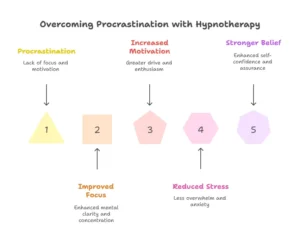 Hypnotherapy doesn’t just help you get started on tasks—it changes the way your mind responds to them. The biggest wins often come from small but powerful shifts in focus, confidence, and habits. Here’s what people commonly experience:
Improved Focus and Mental Clarity
When your mind isn’t cluttered with second-guessing or distractions, it’s easier to lock in on what matters. Hypnotherapy helps quiet that inner noise so you can actually sit down and get things done without constantly bouncing to something else.
Greater Motivation and Drive
Instead of forcing yourself to act, hypnotherapy reconnects you with the why behind your goals. Once the link between effort and reward feels stronger, motivation stops being something you chase—it starts showing up naturally.
Reduced Stress and Overwhelm
A lot of procrastination comes from feeling like a task is “too much.” Hypnotherapy lowers the stress response tied to work, so tasks don’t feel so heavy. With the pressure dialed down, starting becomes less of a fight. For a task you’ve put off all week, ask whether it actually belongs on today’s list. You may need to delegate it, get a missing answer, or schedule it for a time when you can do it. Starting sooner only helps if it’s a task you have reason and resources to do.
Stronger Self-Belief
Doubt is one of procrastination’s favorite tools. If you believe you’ll mess up, you’ll delay. Hypnotherapy helps replace those limiting beliefs with confidence, making it easier to trust yourself and take action without hesitation.
Long-Term Habit Formation
A change is easier to evaluate when you can see it. Note the planned start time and the actual start time for one recurring task. If the gap gets smaller, see what was different. If nothing changes, move the practice to a different time or ask what obstacle you haven’t dealt with yet.
Use Self-Hypnosis to Rehearse How You’ll Stop Procrastinating
If you try an audio session, check whether it has a transcript and whether the hypnotist gives advice you can use. Before bedtime, leave a task where you will see it in the morning. Try the task, record the result and adjust. If you suspect ADHD or anxiety contributes, a qualified clinician can diagnose a condition and talk through options.
Choose a Procrastination Hypnosis Recording You Can Evaluate
You might find a self-hypnosis MP3, a transcript, or a video for overcoming procrastination. If the audio is meant to help you fall asleep, it may be a poor choice just before work. Look for a short practice you can finish, then record how long it took you to start the task. If self-doubt or anxiety keeps interfering, you can ask for more help with procrastination.
Integrating Hypnotherapy Into Daily Life
How Many Sessions Are Typically Needed
Some people notice a shift after just one session, while others need several to really lock in new habits. Think of it like training a muscle—the more consistent you are, the stronger the results. A short series of sessions spread over weeks often gives your subconscious the time it needs to rewire old patterns.
Combining Hypnotherapy With Everyday Strategies
Hypnotherapy is powerful on its own, but pairing it with simple productivity habits makes the change even stronger. Time-blocking, keeping tasks bite-sized, or having an accountability partner can all reinforce the mental shifts you build in sessions. Lifestyle basics like good sleep, exercise, and balanced meals also support clearer focus and energy.
Choosing the Right Hypnotherapist
Working with someone experienced makes the process smoother. Look for a certified hypnotherapist who has worked with procrastination or habit change before. Don’t be afraid to ask questions—like how they run sessions, what approach they use, and what kind of results you can expect. You should feel comfortable and supported, since trust plays a big role in the process. If chronic delay causes problems across school, work, and home, consider discussing it with a licensed clinician. Anxiety, low mood, and attention difficulties can affect task initiation. Bring a few examples so you can talk about what support would fit your situation, especially if simple planning and regular practice have made little difference.
Conclusion
Procrastination may feel like a bad habit you can’t shake, but underneath it’s usually old patterns and beliefs running on autopilot. That’s why willpower alone often fails—you’re pushing against the very part of your mind that’s wired to resist.
Hypnotherapy works differently. By reaching the subconscious, it helps clear the mental roadblocks, shift negative emotions, and rebuild confidence where doubt once lived. The result isn’t just checking things off a to-do list—it’s changing the way you approach tasks altogether.
When paired with simple daily strategies like time-blocking or accountability, hypnotherapy creates lasting change. Instead of constant stress and guilt, you begin to feel lighter, more focused, and more in control of your time.
Breaking the cycle of procrastination doesn’t happen overnight, but it does start with one choice—the choice to do something different. Hypnotherapy can be that difference, helping you trade delay for momentum and hesitation for progress.
