

Personal growth isn’t just about setting goals; it’s about getting past the blocks that keep you stuck. You might want to build confidence, change habits, or stop repeating old patterns, but something deeper keeps pulling you back.
That “something” often lives in your subconscious, the part of your mind that runs on autopilot. This is where hypnotherapy comes in.
Hypnotherapy for personal growth can give you a place to rehearse a change you’re trying to make. Instead of asking for a general boost in motivation, bring a situation you can describe, such as returning to creative work after dinner or asking for help before your schedule is full.
In this guide, we’ll explain how hypnotherapy supports your growth journey, where it fits in, and why it works when other methods fail. Let’s break it down.
How Does Hypnotherapy Use Hypnosis?
Hypnotherapy is a guided process that helps you enter a deeply focused, relaxed state, similar to the moments just before sleep. In this state, your mind becomes more open to new thoughts and ideas. That’s what makes it easier to shift old habits, beliefs, or emotional patterns. During guided hypnosis, the practitioner may ask you to focus on your breathing, a sound, or an imagined scene. Agree on the suggestion beforehand. If you want to practice saying no, for instance, you can agree on a sentence that sounds like something you’d actually say. You can ask to pause an exercise or change words that don’t fit.
You’re not asleep, and you don’t lose control. You stay aware of what’s happening. The goal isn’t to erase your thoughts, it’s to help your mind pause long enough to reset.
Think of your subconscious like a playlist running in the background. It holds the stories, fears, and habits you’ve picked up over the years. Hypnotherapy helps you update that playlist without force or pressure by speaking to the part of your brain that responds best to suggestion.
The process often starts with calming your body, then guiding your focus inward. Once you’re relaxed, the therapist introduces simple, clear suggestions that match your goals whether it’s building confidence, reducing anxiety, or breaking a habit.
This isn’t magic. It’s your brain doing what it’s built to do: learn, adapt, and change.
Now that you know how it works, let’s look at why hypnotherapy is often the missing piece when progress feels stuck.
Why a New Habit Needs a Specific Plan
Practical planning has its own evidence. In a review of 94 tests of implementation intentions, linking an action to a specific situation helped people reach goals. That research tested planning and does not prove that hypnosis produces personal growth. It provides a way to make a suggestion more concrete: when a familiar cue happens, name the behavior you intend to practice.
- Logic doesn’t override habits. You may know what to do, but still feel stuck repeating the same behavior. That’s not a lack of discipline, it’s your subconscious running the show.
- Talk therapy brings awareness, but not always change. Understanding a problem isn’t the same as solving it. Insight helps, but it doesn’t always shift your automatic reactions.
- Motivation fades. Willpower works short-term, but if deeper beliefs haven’t changed, old patterns return.
- Most tools don’t reach the root. Journaling, planning, or reading can help you reflect, but they don’t always reach the emotional blocks underneath.
That’s where hypnotherapy steps in—it works below the surface, where your habits, fears, and beliefs are actually formed. Afterward, ask whether what happened matched your prediction. That distinction can make your next practice more specific and easier to evaluate.
Using Clinical Hypnosis in a Personal Development Plan
In an initial hypnosis session, identify a specific habit or negative thought pattern you want to address. For a work goal, that might be pausing when you assume a colleague’s feedback is a judgment. Guided suggestions can help you rehearse a reply. Discuss what changed in the actual conversation during later hypnotherapy sessions. If a psychological disorder, addiction or phobia affects your goal, get appropriate care from a qualified clinician.
How Self-Hypnosis Might Fit With Personal Growth
Hypnotherapy doesn’t fix everything, but it can speed up growth in ways most tools can’t. Here are five powerful areas where it makes a real difference: For example, suppose you want to ask for clearer feedback at work. Rehearse the moment when a colleague says your work looks fine and starts to move on. Try asking, “What’s one thing you’d change if we had more time?” Then use the question on a low-stakes project and notice what the answer gives you.
- 1. Breaking Limiting BeliefsMany of us carry silent beliefs like “I’m not good enough” or “I always fail.” These often come from childhood or past failures and sit just below awareness.Hypnotherapy helps uncover and replace those beliefs with more helpful ones. Instead of pushing through self-doubt, you train your brain to see new possibilities, without the constant inner fight.
- 2. Changing Habits at the RootBad habits aren’t just about behavior—they’re about what your brain thinks feels safe or familiar. That’s why it’s so hard to quit even when you want to.Hypnotherapy works beneath the habit. It helps reset the emotional triggers that keep you stuck and makes it easier to stick to healthier choices without relying on willpower alone.
- 3. Reducing Anxiety and OverthinkingAnxiety often lives in the body, not just the mind. It’s a learned response—and it can be unlearned.Through relaxation and guided focus, hypnotherapy teaches your brain to feel safe again. Over time, this helps calm racing thoughts, release tension, and build a more steady, grounded state.
- 4. Building Confidence and Self-WorthIf you’ve ever felt like you’re faking it, or waiting to be “ready,” that’s a confidence issue rooted in identity.Hypnotherapy helps shift that identity from the inside. Instead of just telling yourself you’re enough, you start to believe it—and act like it.
- 5. Letting Go of Emotional BaggageOld emotional wounds don’t just disappear with time—they live in your body and behavior.Hypnotherapy gives you a safe space to process those emotions and let them go. It’s not about digging up pain—it’s about giving it somewhere to land so you can move forward lighter.
Build a Personal Growth Habit With Self-Hypnosis
Using a hypnotic suggestion as a therapeutic exercise is one way to reframe negative self-talk. The practice is most specific when it connects positive suggestions to a situation you face. If a conversation affects your career growth, practise the first sentence you’ll say and see whether you can use it without waiting to feel completely ready.
How to Prepare for a Hypnosis Session
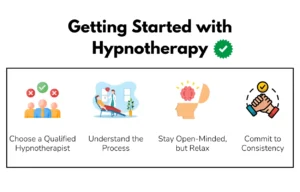 Trying hypnotherapy doesn’t have to feel overwhelming. Here’s how to begin—step by step. When choosing a practitioner, ask what a session can address and what training they have. If your goal turns out to involve long-standing distress or trauma, it may be useful to work with a licensed mental health professional. A session should have a purpose you agree on, and you should be able to say when you want to stop or change direction.
- 1. Find a Qualified HypnotherapistStart by checking credentials. Look for someone certified by a recognized board, with experience in the area you want to work on—like anxiety, confidence, or habits.Read reviews. Ask questions. You should feel safe, understood, and never judged. A good therapist explains the process clearly and doesn’t promise instant results.
- 2. Know What to ExpectYour first session usually includes a short chat, a bit of relaxation, and some light hypnosis work. You stay fully awake and aware—you’re just in a calm, focused state.You may not feel “hypnotized” in a dramatic way, but that doesn’t mean it’s not working. Changes often start small and build over time.
- 3. Be Open, But Don’t Force ItYou don’t need to “believe in hypnosis” for it to work. You just need to be open to the process.If you try to control it or “test” it, your mind stays on guard. The more you relax, the more your mind can respond.
- 4. Stay ConsistentGrowth takes repetition. One session may feel helpful, but change usually happens over a few weeks.Think of it like working out—one visit won’t change your life, but regular sessions can shift your mindset for good.
What to Ask About Self-Hypnosis and Hypnotic Suggestions
A consultation is your chance to ask about clinical training and agree on the scope of the work. Some providers describe habits as part of the subconscious mind, but the practical test is whether you can repeat the desired behaviour after the session. Choose positive affirmations you find believable, then use a simple cue to practice the action. You can try self hypnosis at a regular time and see whether it affects a specific everyday habit.
Combining Hypnotherapy with Other Growth Tools
Hypnotherapy works even better when it’s part of a bigger routine, not a stand-alone fix. You don’t need to give up what’s already helping you. In fact, combining tools often makes the whole process more effective.
Pairing Hypnotherapy with Coaching, Journaling, or Meditation
- With coaching: Hypnotherapy helps you move past mental blocks that slow your progress. If coaching sets the goals, hypnosis clears the resistance.
- With journaling: After each session, write down what came up—thoughts, feelings, memories. This helps you connect the dots and track changes over time.
- With meditation: Both help you focus and slow down. But while meditation clears your mind, hypnotherapy gives your mind new direction.
You don’t need a full plan—just start with one thing and build from there. Give each tool a clear job. A journal can help you notice the situations where you hesitate. Guided imagery can let you rehearse one of them. A conversation with a friend can give you feedback afterward. At the end of the week, write down one action you took and whether it made the next attempt easier.
Building a Simple Growth Routine
- Space out sessions so your mind has time to process. Weekly or biweekly works for most people.
- Between sessions, reflect. What feels different? What’s easier? What still feels stuck?
- Stick with it. Like exercise or therapy, results build over time, not overnight.
Conclusion
Growth isn’t about doing more. It’s about clearing what’s in the way.
Hypnotherapy helps you stop battling your mind and start working with it. Instead of forcing change, you shift the patterns running quietly in the background—the ones that shape your confidence, choices, and beliefs.
If you’ve been trying to grow but keep circling the same blocks, hypnotherapy might be the missing piece. It won’t fix everything, but it will help you move with less resistance and more ease.
Start simple. One session. One shift. Then let the change ripple out.
