
You’re not the same person you were twenty years ago.
Your life looks different. Your priorities look different. The people around you, the way you spend your time, the things that matter to you, all of it has shifted, probably more than once.
But you’re still smoking.
And if you’ve ever thought I know I should quit, I just can’t, this post is for you. Because the reason most long-term smokers struggle to quit has nothing to do with nicotine dependence, and everything to do with a very specific psychological phenomenon: your brain is still running a pattern that belongs to a version of your life that no longer exists.
Understanding this doesn’t just explain why you’re stuck. It points directly to the only thing that actually resolves it.
Table of Contents
Your Brain Builds Patterns for Survival, Not for Accuracy.
The brain’s primary job isn’t to make sure your behavior reflects your current circumstances. Its job is efficiency and survival. It builds patterns of deeply encoded associations between situations, emotions, and behaviors, so you don’t have to think through every response to every moment consciously.
Once a pattern is formed through repetition and emotional charge, the brain treats it as a resource. Something that worked before. Something to reach for automatically when a familiar signal appears.
The problem is that the brain doesn’t automatically reassess those patterns when life changes. It doesn’t notice that the original context is gone and flags the behavior for review. The pattern just keeps running efficiently, automatically, below the level of conscious thought until something actively interrupts it.
This is why you can know, with absolute certainty, that you want to quit. You can understand the health consequences. You can have strong motivation. And still reach for a cigarette the moment a familiar trigger appears.
You’re not weak. Your brain is doing exactly what it was designed to do. It’s just doing it with outdated information.
How Smoking Gets Encoded in the First Place.
Most people can trace the beginning of their smoking habit to a very specific set of circumstances.
For a lot of long-term smokers, it started during a highly social phase of life. Bars. Parties. Friend groups where everyone smoked. Workplaces with a culture built around smoke breaks. Environments where lighting up was a way to belong, to connect, to signal something about who you were.
The emotional charge around those experiences, connection, inclusion, relief, and belonging is exactly what makes the association stick. The brain encodes it: Smoking = connection. Smoking = belonging. Smoking = relief from stress. The stronger the emotion, the deeper the encoding.
Over time, the behavior becomes automatic. You don’t consciously decide to smoke in moments of stress or transition. Your nervous system signals for it before your conscious mind has even registered what’s happening.
That’s how thoroughly integrated the pattern becomes.
Then Life Changed. The Pattern Didn’t Receive the Update.
At some point, maybe gradually, maybe through a major life transition, the original context disappeared.
You’re not going to bars on Friday nights. The friend group that smoked together has dispersed. The job with smoke breaks is a decade behind you. You have different responsibilities, different relationships, a different daily life entirely.
The reasons that made smoking make sense in your 20s or 30s are either gone or look completely different now.
But the pattern is still running.
Because the brain doesn’t automatically update behavioral patterns based on changed circumstances. That update requires deliberate intervention at the level where the pattern lives. Without that intervention, the brain continues to treat the old association as valid and continues to generate the signals that maintain the behavior.
This is why willpower alone doesn’t work. Willpower is a conscious mechanism. You’re using it to override a subconscious pattern. And in any sustained conflict between the conscious and subconscious mind, the subconscious wins. Every time. It has more resources, more speed, and it’s been running this particular program for years.
A Self-Assessment: Is Your Brain Running Outdated Software?
Answer these honestly.
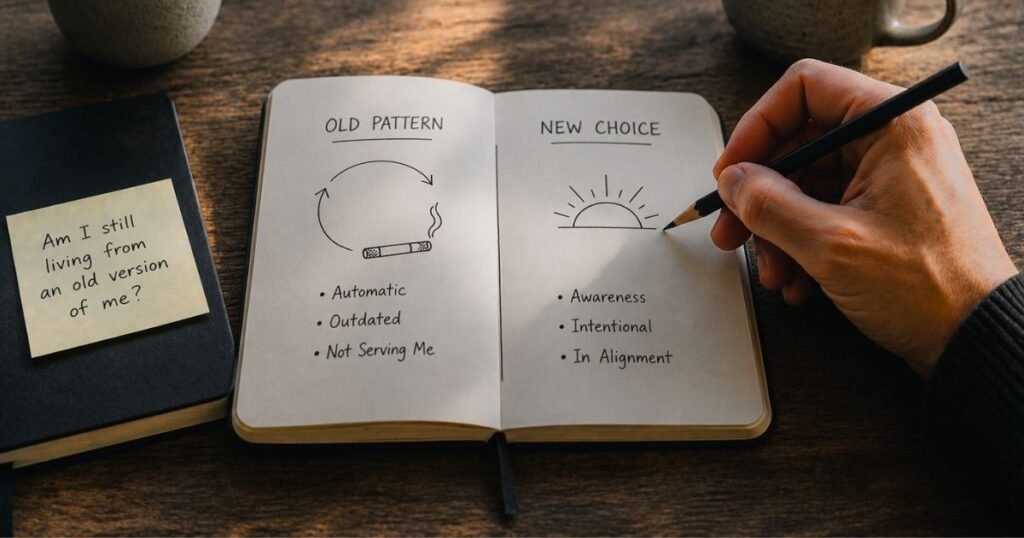
1. When did you start smoking, and what was your life like then? Write down the phase of life, the social environment, and the emotional context. Be specific. Who were you around? What did smoking give you access to?
2. Is that life still your life today? Are you still in the same social environment? Are the same people around you? Is smoking still a functional social tool, or is it a habit running independently of any real-world context?
3. What do you tell yourself smoking does for you now? Stress relief. A break. Something to do with your hands. Now ask: do other people get stress relief without smoking? Do they take breaks without cigarettes? The answer is yes, which means smoking isn’t providing something you can’t get elsewhere. Your brain has just tied those experiences together so tightly that it can’t imagine them separately.
4. If you imagine yourself as a non-smoker, what would feel like it would be lost? This one matters. If the answer involves a sense of identity, a connection to who you used to be, or a particular era of your life, pay attention to that. It’s telling you something important about what your subconscious is actually protecting.
5. Has the original reason you started smoking still been present in your life today? Yes or no. Be honest.
If you answered no to question five, and most long-term smokers do, you’re not protecting a current need. You’re protecting an outdated pattern for a life that’s already over.
Why This Matters More Than Motivation
Most quit-smoking approaches are built on the assumption that what smokers need is more motivation, more information, or a stronger behavioral strategy.
None of that addresses the actual issue.
If your brain is running an outdated pattern at the subconscious level, adding more conscious-level effort just increases the conflict. The signals keep coming. The resistance keeps building. And eventually, most people conclude that they simply aren’t capable of quitting, that it’s somehow harder for them than for other people.
It’s not. They’re just using the wrong tool.
The right tool works at the level where the pattern lives. Not suppressing the behavior from the outside. Not layering more conscious effort on top of a subconscious drive. Actually going into the subconscious and collapsing the association that’s been generating the signal all along.
When that happens, something shifts that clients consistently describe as unexpected. The cigarette stops making sense. Not because they’re resisting. Not because they’re white-knuckling it. But because the part of their brain that was calling for it has been updated.
That’s what the Identity Evolution Method™ does. And it’s why most clients complete the process in one to two sessions, not because it’s a shortcut, but because it goes to the right level from the start.
Your Brain Can Update. It Just Needs the Right Intervention.
Neuroplasticity, the brain’s ability to form new patterns and release old ones, isn’t something that only happens in childhood. It’s available throughout your life. The brain can update its associations. It does it constantly.
The reason your smoking pattern hasn’t updated isn’t that your brain is stuck. It’s because updating a deeply encoded subconscious pattern requires working at the subconscious level. Reading this article won’t do it. Knowing the health consequences won’t do it. Deciding very firmly that you’re done won’t do it either, though that decision matters as a starting point.
What actually does it is a specific process that bypasses the conscious mind’s defenses, accesses the subconscious where the association lives, and creates a different resolution. One that tells your nervous system: that pattern is no longer needed. The chapter it belonged to is closed.
When the pattern collapses, you’re not fighting yourself anymore. There’s nothing to fight.
The Old Version Doesn’t Need You to Keep the Habit
Here’s what I want to leave you with.
The version of you that started smoking, the one who was social and young and standing outside bars and finding connections through cigarettes, was real. That chapter of your life was real. You don’t need to hold onto the habit to honor it.
Letting go of the pattern doesn’t erase who you were. It just means you’ve finished that chapter and you’re living in a different one now.
Your brain hasn’t caught up yet. But it can.
If you’re ready to find out exactly what pattern your brain is still running and collapse it at the root, book a free smoking assessment. That’s where we start.
What you don’t change, you choose.
