
You’ve read the books. Allen Carr. The Easy Way to Stop Smoking. Maybe more than once.
You’ve tried cold turkey multiple times.
You’ve downloaded the apps. You’ve watched the YouTube videos. You’ve listened to the podcasts.
You’ve tried nicotine patches, gum, lozenges. You’ve set quit dates. You’ve thrown away packs.
And you’re still smoking.
So what does that mean?
Does it mean you’re broken? That you’re not trying hard enough? That you don’t actually want to quit?
No.
It means your smoking isn’t just a conscious habit you can intellectually decide to stop.
It means your smoking is subconscious. And no amount of information will fix a subconscious problem.
Let me explain when DIY methods work, when they don’t and what to do instead.
Table of Contents
When DIY Quitting Methods Actually Work
Let me be clear from the start: DIY methods absolutely work for some people.
Books like Allen Carr’s The Easy Way to Stop Smoking have helped millions of people quit. Cold turkey works. Apps work. For the right person, these methods are incredibly effective.
So when do they work?
DIY methods work when your smoking is thought-driven.
What “Thought-Driven” Smoking Looks Like:
- You picked up smoking casually at parties, socially, occasionally
- You can go days without smoking and not think about it
- Smoking is a habit you do automatically, but there’s no deep emotional attachment
- You smoke because “everyone does” or because it’s convenient, not because you need it
- You’ve never used smoking to cope with stress, trauma, or overwhelming emotions
- You don’t identify strongly as a smoker
If this describes you, then quitting is mostly about:
- Reframing your thoughts about smoking
- Breaking the automatic pattern (morning cigarette, after-meal cigarette)
- Understanding the logic of why smoking doesn’t actually provide what you think it does
For this type of smoker, Allen Carr’s book is perfect. Cold turkey is perfect. An app that helps you track cravings and stay accountable is perfect.
Because your smoking lives in your conscious mind. So conscious tools can address it.
The Social Smoker vs. The Dependent Smoker
Here’s a good litmus test:
If you only smoked when you were out with friends, and you could easily go weeks without smoking and not think about it, you’re probably a social smoker. DIY methods will work for you.
If you smoke every day, if smoking is how you manage stress, if you’ve tried to quit multiple times and it didn’t stick, you’re probably a dependent smoker. DIY methods probably won’t be enough.
The difference isn’t about willpower. It’s about where the habit lives in your brain.
The Difference Between Conscious Habits and Subconscious Patterns
Let me explain what I mean by “conscious habit” vs. “subconscious pattern.”
Conscious Habit:
A behavior you do automatically, but it’s not tied to emotional need or identity. You could stop it with awareness and intention.
Example: Biting your nails when you’re bored. Scrolling social media before bed. Ordering the same coffee every day.
These habits are autopilot behaviors, but they’re not protecting anything deep. They’re just patterns your brain has learned.
Subconscious Pattern:
A behavior that’s wired into your nervous system as a survival strategy. Your brain believes this behavior is keeping you safe, helping you cope, or protecting your identity.
Example: Smoking when you’re stressed because that’s how you learned to calm your nervous system 15 years ago. Smoking because it’s tied to who you believe you are. Smoking because it’s the only way you know how to regulate overwhelming emotions.
These patterns aren’t just habits. They’re protective mechanisms.
And you can’t eliminate a protective mechanism with logic alone.
Signs Your Smoking Is Subconscious (Not Just a Bad Habit)
So how do you know if your smoking is subconscious?
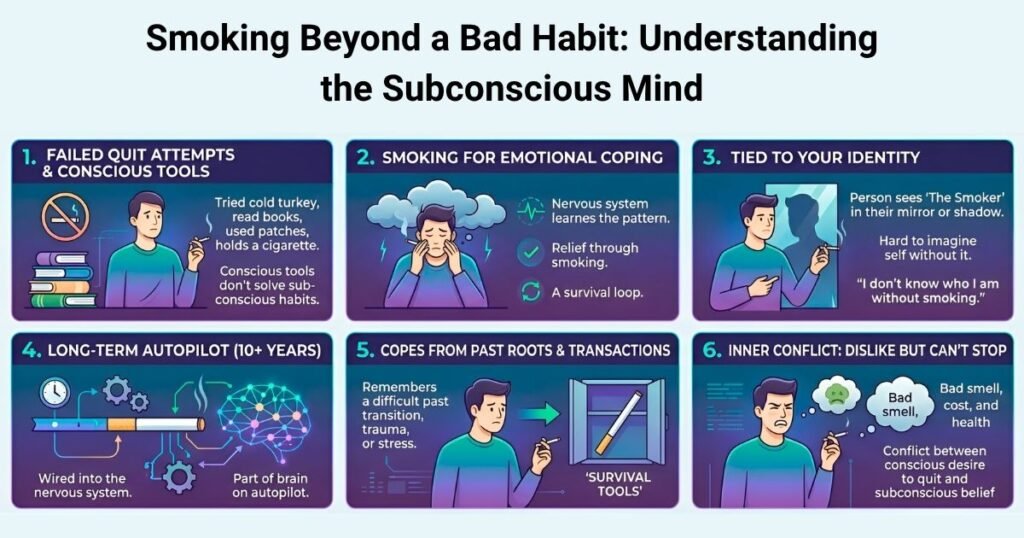
Here are the signs:
Sign #1: You’ve Tried to Quit Multiple Times, and It Didn’t Stick
If you’ve read the books, tried cold turkey, used nicotine replacement therapy, and you’re still smoking, that’s a sign.
Because conscious habits respond to conscious tools. If the tools aren’t working, the habit isn’t purely conscious.
Sign #2: You Smoke When You’re Stressed, Anxious, or Overwhelmed
If smoking is how you calm down, how you regulate your emotions, how you cope with life, it’s subconscious.
Your nervous system has learned: stress = cigarette = relief.
That’s not a thought-driven habit. That’s a survival pattern.
Sign #3: You Can’t Imagine Who You’d Be Without Cigarettes
If the idea of quitting feels like losing part of yourself, if you think “I don’t know who I am without smoking,” it’s subconscious.
Your identity is tied to smoking. And identity lives in the subconscious.
Sign #4: You’ve Been Smoking for 10+ Years
The longer you’ve been smoking, the more likely it’s subconscious.
Because over time, smoking gets wired into your nervous system. It becomes part of how your brain operates on autopilot.
Sign #5: Smoking Started as a Coping Mechanism
Did you start smoking during a stressful period in your life? After a trauma? During a difficult transition?
If smoking was how you coped with something overwhelming, your brain filed it under “survival tools.”
And your nervous system doesn’t let go of survival tools easily.
Sign #6: You Smoke Even Though You Hate It
If you genuinely don’t enjoy smoking anymore if you hate the smell, the cost, the health impact, the shame but you still can’t stop, that’s subconscious.
Because your conscious mind wants to quit, but your subconscious mind believes you need it.
Why Information Alone Can’t Fix a Subconscious Problem
Here’s the thing about books, apps, and videos:
They give you information. They help you understand smoking intellectually.
And for some people, that’s enough.
But if your smoking is subconscious, understanding it intellectually doesn’t resolve it.
Let me give you an analogy:
Imagine you’re terrified of flying. Someone gives you statistics showing that flying is safer than driving. They explain how planes work. They show you videos of pilots explaining the safety features.
Does that make the fear go away?
Probably not. Because the fear doesn’t live in your conscious, logical mind. It lives in your nervous system.
You can understand that flying is safe and still be terrified.
Smoking is the same way.
You can understand that cigarettes aren’t actually helping you. You can know intellectually that you don’t need them. You can read all the reasons why quitting is good for you.
But if your subconscious mind believes cigarettes are protecting you, if your nervous system is holding onto smoking as a survival tool,l that information won’t change the behavior.
Because you’re trying to solve a subconscious problem with conscious tools.
And that’s not a character flaw. That’s just a mismatch of methods.
What Professional Support Actually Does (That Books and Apps Can’t)
So what does professional support do differently?
Professional support works at the subconscious level. Not the conscious level.
When you work with a hypnotherapist (or other professional who specializes in subconscious work), you’re not getting more information about smoking.
You’re accessing the part of your mind that’s been holding onto smoking and resolving it from the inside out.
Here’s what that looks like:
Step 1: Identify the Subconscious Root
We don’t just talk about smoking as a habit. We explore:
- When did smoking start?
- What was happening in your life at that time?
- What need was smoking meeting?
- What does your nervous system believe smoking is protecting?
This isn’t surface-level conversation. This is deep subconscious exploration.
Step 2: Access the Subconscious Mind
Through hypnotherapy, we bypass your conscious, analytical mind and speak directly to your subconscious.
This is where the automatic patterns live. This is where the protective mechanisms are stored.
And this is the only place where real, lasting change can happen.
Step 3: Collapse the Subconscious Association
Once we’ve identified the root reason your nervous system is holding onto smoking, we can collapse it.
We don’t just cover it up with willpower. We don’t just distract you from it.
We remove it at the source.
We update your subconscious belief system:
- Cigarettes ≠ safety
- Cigarettes ≠ stress relief
- Cigarettes ≠ who you are
And once that shift happens at the subconscious level, the desire to smoke just… stops.
Step 4: Rewire the Automatic Patterns
We also work on rewiring the automatic triggers.
Coffee → cigarette becomes coffee → just coffee.
Stress → cigarette becomes stress → deep breath, new coping tool.
Break → cigarette becomes break → actual rest without needing to smoke.
This happens at the subconscious level, so you’re not using willpower to resist. Your brain just stops reaching for cigarettes automatically.
Step 5: Shift the Identity
This is the most powerful part.
We work with your subconscious to shift your identity from “smoker” to “non-smoker.”
Not as a conscious affirmation you have to repeat. But as a deep, subconscious knowing.
And once your identity shifts, everything changes. Because you’re not resisting cigarettes anymore. You simply don’t identify with them.
How to Know If You Need Help to Quit Smoking
So how do you know if you need professional support?
Ask yourself these questions:
Question 1: Have I Tried DIY Methods and They Didn’t Work?
If you’ve read the books, tried cold turkey, used apps, and you’re still smoking, that’s a sign you need a different approach.
Question 2: Have I Been Smoking for More Than 10 Years?
The longer you’ve been smoking, the more likely it’s wired into your subconscious. Long-term smoking almost always requires subconscious-level work.
Question 3: Do I Use Smoking to Cope With Stress, Anxiety, or Emotions?
If smoking is your coping mechanism, it’s not just a habit. It’s a survival tool. And that requires professional support to resolve.
Question 4: Does the Idea of Quitting Feel Scary or Impossible?
If quitting feels like losing part of yourself, or if you genuinely can’t imagine life without cigarettes, your smoking is tied to identity. That’s subconscious work.
Question 5: Do I Hate Smoking but Still Can’t Stop?
If your conscious mind wants to quit but you keep smoking anyway, that’s the clearest sign that your smoking is subconscious.
Question 6: Am I Tired of Trying and Failing?
If you’re exhausted from quit attempts that don’t stick, you need a method that actually addresses the root cause.
If you answered “yes” to any of these questions, DIY methods probably won’t be enough.
You need to work at the subconscious level.
What Happens When You Address Smoking at the Subconscious Level
Here’s what happens when you work with a professional who addresses smoking at the subconscious level:
The Desire to Smoke Disappears
You’re not white-knuckling it. You’re not resisting cravings every day.
The desire just… stops. Because your subconscious no longer believes you need cigarettes.
You Don’t Feel Deprived
You’re not giving up something you want. You genuinely don’t want it anymore.
That’s the difference between willpower-based quitting and subconscious resolution.
Triggers Stop Pulling You
Coffee, stress, social situations they don’t make you want to smoke anymore.
Because the automatic associations have been rewired at the subconscious level.
You Feel Like Yourself Again
You’re not fighting yourself. You’re not managing two identities.
You’re just one person. A non-smoker.
Most Clients Quit in 1-2 Sessions
When you work at the subconscious level, change happens fast.
Not because you’re focusing harder. But because you’re addressing the actual root cause.
Most of my clients quit in 1 to 2 sessions. Not because they’re special. But because we resolved what their nervous system was protecting.
You’re Not Broken; You’ve Just Been Using the Wrong Tools
If you’ve tried everything and you’re still smoking, I want you to hear this clearly:
You’re not broken. You’re not weak. You’re not lacking willpower.
You’ve just been trying to solve a subconscious problem with conscious tools.
And that’s not your fault.
DIY methods are incredible for the right person. But if they haven’t worked for you, it’s because your smoking isn’t thought-driven. It’s subconscious.
And subconscious patterns require subconscious-level work.
That’s not a failure on your part. That’s just how the brain works.
When to Choose DIY vs. When to Get Professional Help
Here’s a simple framework:
Choose DIY Methods If:
- You’re a casual or social smoker
- You can go days without smoking and not think about it
- You’ve never used smoking to cope with stress or trauma
- Smoking isn’t tied to your identity
- You haven’t tried to quit before (or you’ve only tried once)
Recommended DIY methods: Allen Carr’s book, cold turkey, quit-smoking apps
Get Professional Help If:
- You’ve tried DIY methods and they didn’t work
- You’ve been smoking for 10+ years
- You use smoking to manage stress, anxiety, or emotions
- Smoking is tied to your identity
- You’ve tried to quit multiple times and it didn’t stick
- You feel like you can’t imagine life without cigarettes
Recommended professional support: Hypnotherapy, behavioral therapy, smoking cessation programs that address subconscious patterns
You Deserve Support That Actually Works
If you’ve been struggling to quit on your own, it’s not because you’re not trying hard enough.
It’s because you’ve been using tools that weren’t designed for your type of smoking.
And that’s okay. Now you know.
You don’t have to keep fighting the same battle over and over.
You can work at the level where your smoking actually lives in your subconscious mind.
And when you do that, quitting stops being a battle. It becomes a shift.
A shift in identity. A shift in how your nervous system responds to stress. A shift in who you believe you are.
And that shift? It’s lasting.
Because it’s not about forcing yourself to stop. It’s about becoming someone who simply doesn’t smoke anymore.
Ready to quit without the struggle? Book a free Clarity Call.
