
Most quit-smoking methods teach you how to manage cravings.
Nicotine gum when the urge hits.
Patches to take the edge off.
Vaping instead of smoking.
Breathing exercises to get through the moment.
The idea is simple: when the craving shows up, you cope with it.
But here’s a question most people never ask:
What if cravings didn’t show up at all?
What if instead of getting better at resisting cigarettes, you stop wanting them?
What if the goal wasn’t to manage cravings for the rest of your life, but to eliminate them?
That’s not just wishful thinking. That’s what happens when you work at the level where cravings are actually created in your subconscious mind.
Let me show you the difference between managing cravings and eliminating them, and why one keeps you stuck in a lifelong battle while the other sets you free.
Table of Contents
The Craving Management Industry: Built on One Flawed Assumption
Turn on the TV. Scroll through social media. Walk into a pharmacy.
You’ll see ads for products that help you “manage cravings when they hit.”
Nicotine gum. Nicotine patches. Nicotine lozenges. Vaping devices are marketed as “harm reduction.” Apps that give you tools to “resist the urge.”
Every single one of these products is built on the same assumption:
You will always crave cigarettes. Your job is to get better at managing the craving.
Think about what that means.
It means the entire industry has accepted that the desire to smoke will never fully go away. That you’ll spend the rest of your life fighting an urge. That is the best you can hope for is to become skilled at resisting.
The Message These Products Send:
“You’ll always want to smoke. But we can help you cope with that want.”
“Cravings are inevitable. Here’s how to white-knuckle your way through them.”
“You can’t eliminate the desire. But you can learn to manage it.”
And that message becomes your reality.
Because when you believe cravings are permanent, you don’t look for a way to eliminate them. You just focus on surviving them.
But here’s the truth: these products don’t want you to know:
Cravings are not inevitable. They’re generated by a pattern your brain learned. And patterns can be changed.
Why “Managing Cravings” Keeps You Stuck in the Battle
Let’s talk about what happens when you approach quitting from a “craving management” mindset.
You’re in a Constant State of Resistance
When cravings are something you have to manage, every day becomes a battle.
The craving shows up. You resist it. You use your tools, gum, breathing exercises, and distraction.
The craving fades. You feel relief.
Then a few hours later, it happens again.
This cycle repeats indefinitely.
You’re not free. You’re just getting better at fighting.
You’re Always One Moment Away From Relapse
When the craving still exists, it only takes one weak moment for everything to fall apart.
A stressful day. A triggering situation. A moment when your willpower is depleted.
The craving is still there, waiting. And when your defenses are down, it wins.
You Never Experience True Freedom
Think about what “managing cravings” actually means:
You wake up every day knowing you’ll have to resist the urge to smoke.
You plan your day around avoiding triggers.
You use tools to cope when cravings hit.
You’re constantly aware of smoking even though you’re not doing it.
That’s not freedom. That’s management.
It’s like being on a diet for the rest of your life. You’re not eating the food, but you’re thinking about it constantly. You’re always resisting. Always managing.
True freedom would be not wanting the food in the first place.
And that’s the difference between managing cravings and eliminating them.
What Cravings Actually Are (And Why Your Brain Keeps Creating Them)
So if cravings aren’t inevitable, what are they?
Cravings are signals your brain generates based on learned patterns.
Let me explain how this works:
How Your Brain Learned to Create Cravings
Years ago, something happened in your life. Maybe you were stressed. Maybe you felt overwhelmed. Maybe you needed a break.
You smoked a cigarette. And you felt better.
Your brain recorded that experience:
- Problem: Stress / overwhelm/need for a break
- Solution: Cigarette
- Result: Relief
After enough repetitions, your brain automated the pattern. It didn’t need you to consciously decide to smoke anymore. It just generated the urge automatically.
Trigger → Craving → Behavior → Relief
This became a subconscious loop.
Why Cravings Keep Showing Up
Even after you quit smoking, the pattern is still there.
Your brain is still running the same program: “When stressed, need a cigarette. When bored, I need a cigarette. When triggered, need a cigarette.”
So when those triggers appear, stress, boredom, whatever it is for you, your brain generates a craving.
Not because you’re weak. Not because you’re failing. But because your brain still believes cigarettes are the solution to those triggers.
The craving is your brain’s way of saying: “Hey, we have a problem here. Time to use our solution (cigarettes).”
The Key Insight
Cravings aren’t random. A subconscious pattern generates them.
And if a pattern is generating them, that means they can be stopped at the source.
The Difference Between Managing Cravings and Eliminating Them
Let me show you the fundamental difference between these two approaches:
Managing Cravings:
Goal: Learn to cope with the urge to smoke
Method: Use tools (gum, patches, breathing exercises) to resist when cravings hit
Experience: Constant battle. Daily resistance. White-knuckling through triggers.
Outcome: You don’t smoke, but you still want to. The desire never fully goes away.
Timeline: Indefinite. You’re managing cravings for the rest of your life.
Eliminating Cravings:
Goal: Stop wanting to smoke
Method: Resolve the subconscious pattern that’s generating the cravings
Experience: Natural disinterest. No fight. No resistance.
Outcome: You don’t smoke, and you don’t want to. The desire is gone.
Timeline: Permanent. Once the pattern is resolved, cravings stop being generated.
One is a lifelong battle. The other is freedom.
Why Your Brain Is Still Generating Cravings (Even After You Quit)
If you’ve quit smoking but you’re still experiencing cravings, here’s what’s happening:
You Eliminated the Behavior, But Not the Pattern
When you quit smoking, you stop the physical act of smoking. But you didn’t update the subconscious pattern that created the habit in the first place.
Your brain is still running the old program:
- Stress → Need a cigarette
- Bored → Need a cigarette
- After a meal → Need a cigarette
So when those triggers appear, your brain still generates the craving signal.
You’re not smoking. But your brain is still asking for a cigarette.
The Pattern Is Subconscious
This is why willpower and conscious tools (like nicotine gum) don’t eliminate cravings.
Willpower operates at the conscious level. But the pattern generating cravings is subconscious.
You can consciously decide, “I’m not going to smoke.” But that doesn’t update the subconscious programming.
So the craving keeps showing up. And you have to keep resisting it.
Your Brain Still Believes Cigarettes Are the Solution
Here’s the core issue:
Your nervous system still believes cigarettes solve something important.
Maybe it believes cigarettes help you manage stress.
Maybe it believes cigarettes give you a break.
Maybe it believes cigarettes help you regulate emotions.
Until that belief is updated at the subconscious level, your brain will keep generating cravings.
Because from your brain’s perspective, it’s trying to help you. It’s saying: “Hey, you’re stressed. I know what works for stress. Cigarettes. Let’s do that.”
Your brain isn’t sabotaging you. It’s protecting you with outdated information.
How to Eliminate Cravings at the Source (Not Just Manage Them)
So, how do you actually eliminate cravings instead of just managing them?
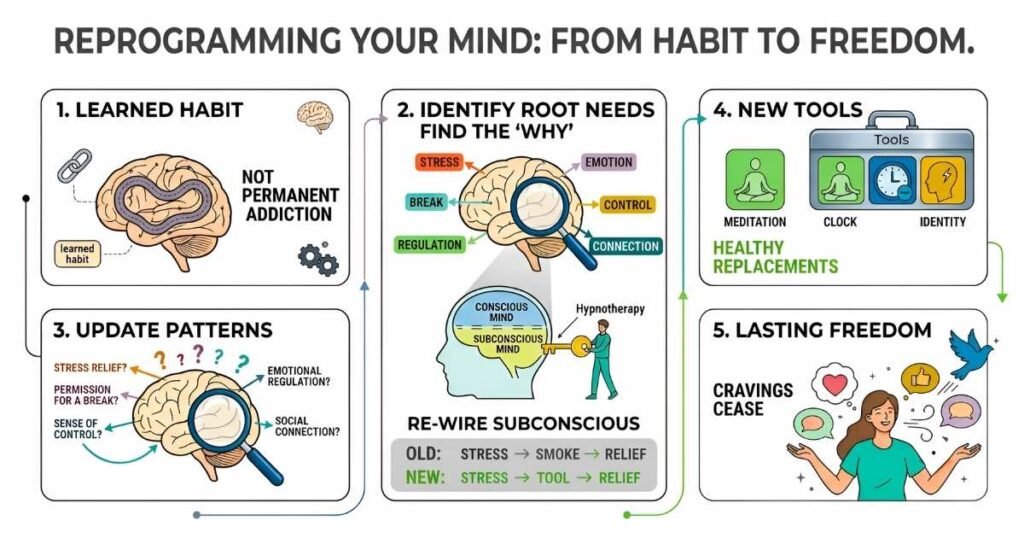
Step 1: Understand That Cravings Are Generated by a Pattern
First, you need to shift your understanding.
Cravings aren’t a mysterious force. They’re not proof that you’re addicted forever.
They’re signals generated by a subconscious pattern that your brain learned years ago.
Once you understand that, you can address the pattern directly.
Step 2: Identify What the Pattern Is Protecting
The pattern exists because at some point, your brain decided smoking solved something.
What was it solving?
- Stress relief?
- Permission to take a break?
- Emotional regulation?
- A sense of control?
- Social connection?
This is the root cause. And until it’s addressed, the pattern will keep running.
Step 3: Work at the Subconscious Level
Here’s where most people get stuck.
You can consciously understand that cigarettes don’t actually solve your problems. But that doesn’t update the subconscious belief.
You need to work at the subconscious level to resolve the pattern.
That’s what hypnotherapy does.
Through hypnotherapy, we access your subconscious mind, the part that’s generating the cravings and we update the programming:
Old pattern: Stress → need cigarette → relief
Updated pattern: Stress → use new coping tool → relief
We don’t just tell you this consciously. We install it subconsciously.
Step 4: Install New Tools
It’s not enough to just remove the old pattern. Your brain needs new ways to meet the needs that smoking was filling.
If smoking was your stress relief, we install new nervous system regulation tools.
If smoking was your break, we work on permitting yourself to pause without needing a cigarette.
If smoking were tied to your identity, we would help you redefine who you are without it.
Step 5: The Pattern Stops Generating Cravings
Once the subconscious pattern is updated, something remarkable happens:
The cravings stop showing up.
Not because you’re resisting them better. But because your brain stops generating them.
Your brain no longer believes cigarettes are the solution. So it stops sending the craving signal.
And when the signal stops, there’s nothing to resist.
What Freedom From Cravings Actually Feels Like
Let me paint you a picture of what life looks like when cravings are eliminated, not just managed.
You Don’t Think About Smoking
You’re not constantly aware of cigarettes. You’re not planning your day around avoiding triggers. You’re not bracing yourself for the next craving.
Smoking just… doesn’t cross your mind.
Triggers Don’t Pull You
You can have coffee. You can feel stressed. You can be in situations where you used to smoke.
And nothing happens. No craving. No pull. No internal battle.
Because the association has been resolved at the subconscious level.
You Don’t Feel Like You’re Missing Out
When you’re managing cravings, part of you still wants cigarettes. You’re just stopping yourself from having them.
But when cravings are eliminated, you genuinely don’t want them.
It’s not deprivation. It’s disinterested.
You Can Be Around Smokers and Feel Nothing
You’re at a bar. Someone lights up next to you. The smell hits you.
And you feel… nothing.
No craving. No temptation. No “I wish I could have one.”
Just neutral. The way a non-smoker feels.
You’re Free
This is what true freedom feels like.
Not managing. Not resisting. Not white-knuckling.
Just… free.
The Real Question: Do You Want to Manage Cravings Forever, or Eliminate Them?
Here’s what it comes down to:
Do you want to spend the rest of your life managing cravings? Or do you want to eliminate them?
If you’re okay with a lifelong battle, if you’re fine with resisting the urge every day, using nicotine gum when cravings hit, constantly being aware of smoking even though you’re not doing it, then keep doing what you’re doing.
But if you want actual freedom, if you want to stop wanting cigarettes entirely, you need to work at the level where cravings are generated.
You need to resolve the subconscious pattern.
Because when that pattern updates, you don’t become better at saying no.
You become someone who no longer wants to say yes.
And that’s the difference between management and freedom.
Ready to quit without the struggle? Book a free Clarity Call.
