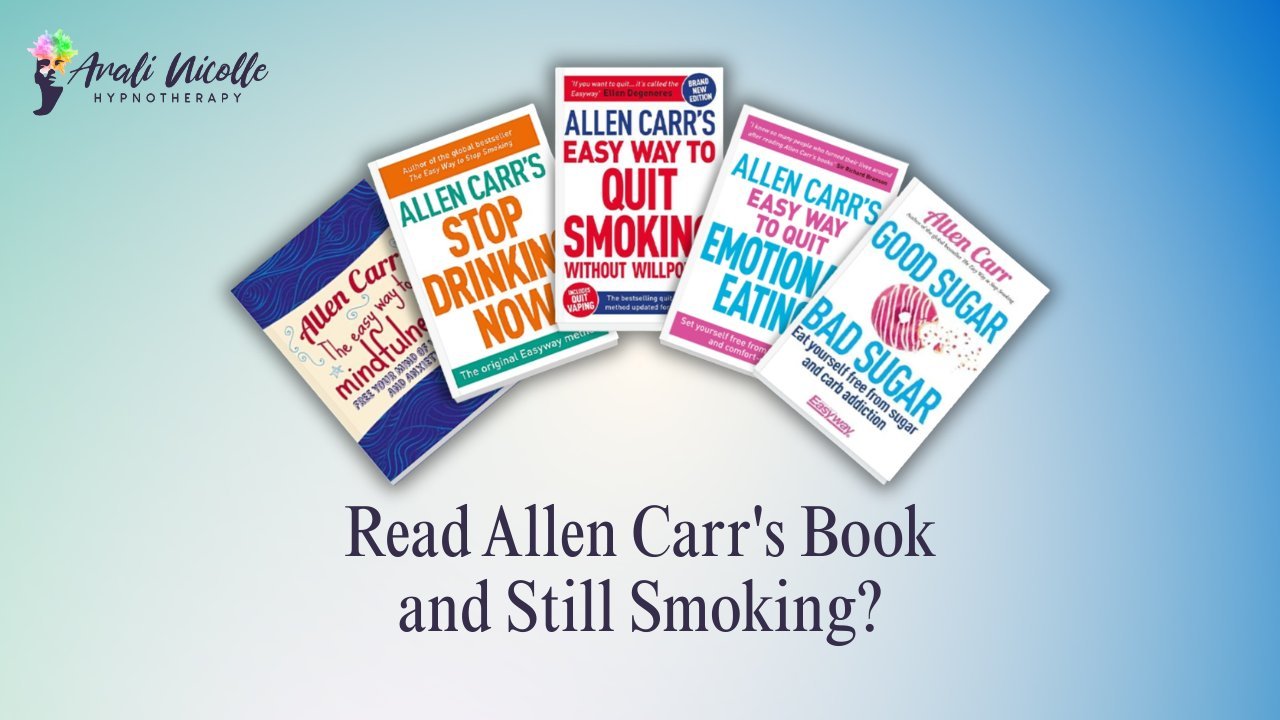
If Allen Carr’s The Easy Way to Stop Smoking worked for you, you wouldn’t still be smoking.
And I want to be clear about something right from the start:
His work is brilliant. It has helped millions of people quit smoking.
If you’re one of those people, that’s incredible. Allen Carr’s method is powerful, and for many smokers, it’s exactly what they need.
But if you’re reading this, you’re probably not one of those people.
You read the book. You understood it. You agreed with everything he said. You even felt motivated.
And you’re still smoking.
So what does that mean? Does it mean you didn’t “get it”? That you’re not ready? That you’re somehow more addicted than the people for whom it worked?
No.
It means your smoking isn’t the type of smoking Allen Carr’s method was designed to address.
Let me explain why the book didn’t work for you—and what to do instead.
Table of Contents
How Allen Carr’s Method Works (And Why It’s Brilliant)
Before we talk about why the book didn’t work for you, let’s talk about why it does work for so many people.
Allen Carr’s method is based on a simple but powerful premise:
Smoking is a trap. And once you see the trap, you can walk out of it.
Here’s how he dismantles the illusion:
He Shows You That Cigarettes Don’t Give You Anything
Most smokers believe cigarettes provide:
- Stress relief
- Enjoyment
- Confidence
- A break
- Focus
Allen Carr systematically breaks down each of these beliefs and shows you they’re illusions.
The “relief” you feel when you smoke? That’s just ending the withdrawal from the last cigarette.
The “enjoyment”? You’ve been conditioned to associate pleasure with something that’s actually harming you.
The “break”? You could take a break without smoking.
He helps you see that you’re not giving up anything when you quit. Because cigarettes never gave you anything in the first place.
He Reframes Quitting as Liberation, Not Deprivation
Most quit-smoking methods frame quitting as sacrifice:
“You can’t have cigarettes anymore.”
“You need to resist the urge.”
“You’re giving up something you enjoy.”
Allen Carr flips that:
“You’re not giving up anything. You’re escaping a trap.”
“You’re gaining freedom, not losing something.”
“There’s nothing to resist because cigarettes don’t provide what you think they do.”
This reframe is psychologically powerful. Because when you truly believe you’re not losing anything, quitting doesn’t feel like deprivation.
He Works at the Cognitive Level
Allen Carr’s method is all about changing how you think about smoking.
He uses logic, reason, and cognitive reframing to help you see smoking differently.
And for many people, that’s all it takes.
Once they understand the trap intellectually, they can walk away from cigarettes.
That’s the brilliance of his method. And that’s also its limitation.
When Cognitive Reframing Is Enough to Quit Smoking
Allen Carr’s method works incredibly well for a specific type of smoker.
If your smoking is primarily thought-driven, cognitive reframing can set you free.
Thought-Driven Smoking Looks Like:
- You picked up smoking casually—socially, at parties, because it was cool
- You smoke out of habit, not emotional need
- You don’t use cigarettes to cope with stress, trauma, or overwhelming emotions
- Smoking isn’t deeply tied to your identity
- You can go days without smoking and not feel emotionally destabilized
- You smoke because you believe cigarettes provide something—and once you realize they don’t, you can stop
For this type of smoker, Allen Carr’s book is perfect.
Because once you intellectually understand that cigarettes aren’t providing what you thought they were, the behavior loses its appeal.
You see the trap. You walk out. You’re free.
But if you’re still smoking after reading the book, your smoking isn’t thought-driven.
Why Allen Carr’s Book Doesn’t Work for Everyone
Here’s what most people don’t understand:
Not all smoking is cognitive. Some smoking is subconscious.
And you can’t resolve a subconscious problem with conscious understanding.
Let me explain the difference:
Cognitive Smoking:
- Based on beliefs and thought patterns
- “I smoke because I think cigarettes help me relax”
- Can be resolved by changing your thoughts
- Responds well to logic and reframing
Subconscious Smoking:
- Based on identity, nervous system protection, and emotional programming
- “I smoke because my nervous system believes cigarettes are keeping me safe”
- Cannot be resolved by changing your thoughts alone
- Requires deeper subconscious work
Allen Carr’s method works for cognitive smoking. It doesn’t work for subconscious smoking.
And if you read the book and you’re still smoking, it’s because your smoking is subconscious.
The Difference Between Cognitive Smoking and Subconscious Smoking
Let me show you what subconscious smoking looks like:
Your Smoking Started as a Coping Mechanism
Maybe you started smoking 15 years ago when you were going through something overwhelming—a breakup, a loss, a stressful period in your life.
Your nervous system was dysregulated. You felt out of control. And cigarettes helped you feel calm.
Your brain recorded that as: “Cigarettes = safety.”
Now, 15 years later, that programming is still there. Even if you consciously know cigarettes aren’t actually helping, your subconscious still believes they are.
Allen Carr can explain logically why cigarettes don’t relieve stress. But that doesn’t update the subconscious programming.
Your Smoking Is Tied to Identity
Maybe smoking became part of who you are.
The version of you that smokes is confident, in control, rebellious, or independent.
And quitting feels like losing that version of yourself.
Allen Carr can help you understand intellectually that cigarettes don’t define you. But if your identity is woven into smoking, reading a book won’t untangle it.
Your Smoking Is How You Regulate Emotions
Maybe cigarettes are how you’ve learned to process anxiety, anger, sadness, or overwhelm.
When emotions feel too big, you smoke to create distance from them.
Allen Carr can show you logically that cigarettes don’t actually regulate emotions. But if you’ve never learned another way to cope, that understanding doesn’t give you a replacement tool.
Your Nervous System Believes Smoking Is Protection
This is the deepest level.
Your nervous system—the part of your brain that governs survival—has decided that cigarettes are necessary for your wellbeing.
Not because you consciously believe that. But because at some point, your brain made that association, and it never updated.
Allen Carr speaks to your conscious mind. But your nervous system doesn’t listen to logic. It listens to protection.
And if smoking is being protected at the nervous system level, no amount of cognitive reframing will override it.
Signs Your Smoking Is Subconscious (Not Just a Thought Pattern)
How do you know if your smoking is subconscious?
Here are the signs:
Sign #1: You Read Allen Carr (or Other Books) and You’re Still Smoking
If cognitive reframing worked for you, the book would have been enough.
The fact that you understood everything intellectually but couldn’t stop smoking tells you: this isn’t a thought problem. It’s a subconscious problem.
Sign #2: You’ve Been Smoking for 10+ Years
The longer you’ve been smoking, the more likely it’s wired into your subconscious as an automatic pattern and identity marker.
Short-term smoking is easier to address cognitively. Long-term smoking almost always requires subconscious work.
Sign #3: You Use Smoking to Manage Stress or Emotions
If cigarettes are your primary coping mechanism for stress, anxiety, anger, or overwhelm, that’s subconscious.
Your nervous system has learned: “Stress = cigarette = calm.”
That’s not a thought. That’s a survival pattern.
Sign #4: Quitting Feels Like Losing Part of Yourself
If the idea of quitting makes you think “I don’t know who I’d be without cigarettes,” that’s identity-level smoking.
And identity lives in the subconscious.
Sign #5: You Hate Smoking But Can’t Stop
If you consciously want to quit—if you hate the smell, the cost, the health impact—but you still can’t stop, that’s the clearest sign.
Your conscious mind wants to quit. But your subconscious is holding on.
And conscious understanding (like reading a book) can’t override subconscious programming.
Sign #6: You’ve Tried Multiple Methods and Nothing Has Stuck
If you’ve tried books, apps, patches, gum, cold turkey, and you keep coming back to smoking, you’re dealing with something deeper than conscious choice.
You need subconscious-level work.
What Subconscious Work Actually Does (That Books Can’t)
So what does subconscious work look like? And how is it different from reading a book?
Books Work at the Conscious Level
When you read Allen Carr (or any quit-smoking book), you’re processing information with your conscious mind.
You’re learning. You’re understanding. You’re reframing your thoughts.
And for some people, that’s enough. Because their smoking lives at the conscious level.
But if your smoking lives in your subconscious, conscious understanding doesn’t reach it.
You can know intellectually that cigarettes don’t help and still feel like you need them.
Hypnotherapy Works at the Subconscious Level
Hypnotherapy bypasses the conscious mind and speaks directly to the subconscious—the part of your brain where automatic patterns, emotional programming, and identity beliefs are stored.
Here’s what that looks like:
Step 1: Identify the Subconscious Root
We don’t just talk about smoking as a habit. We explore:
- When did smoking start?
- What was happening emotionally at that time?
- What need was smoking meeting?
- What does your nervous system believe smoking is protecting?
This isn’t surface-level conversation. This is deep subconscious exploration.
Step 2: Access the Subconscious Programming
Through hypnotherapy, we work directly with the part of your mind that’s holding onto smoking.
Not the part that knows you should quit. The part that believes you need to smoke.
Step 3: Resolve the Root Cause
Once we’ve identified why your nervous system is protecting smoking, we can resolve it.
We don’t just cover it up with willpower or logic. We remove it at the source.
We update the subconscious belief:
- Cigarettes ≠ safety
- Cigarettes ≠ stress relief
- Cigarettes ≠ who you are
Step 4: Rewire the Automatic Patterns
We also work on the automatic associations your brain has built:
Coffee → cigarette becomes coffee → just coffee.
Stress → cigarette becomes stress → deep breath, new coping tool.
This happens at the subconscious level, so you’re not using willpower to resist. Your brain just stops reaching for cigarettes automatically.
Step 5: Shift the Identity
We work with your subconscious to shift your identity from “smoker” to “non-smoker.”
Not as a conscious affirmation. But as a deep, subconscious knowing.
And once that identity shifts, you’re not resisting cigarettes anymore. You simply don’t identify with them.
What to Do If Allen Carr’s Method Didn’t Work for You
If you read The Easy Way to Stop Smoking and you’re still smoking, here’s what you need to know:
You didn’t fail. The book didn’t fail. You just need a different approach.
Allen Carr’s method is brilliant for cognitive smoking. But if your smoking is subconscious, you need subconscious work.
Here’s what that looks like:
Step 1: Acknowledge That Your Smoking Is Subconscious
Stop blaming yourself for “not getting it” or “not trying hard enough.”
The book didn’t work because your smoking isn’t cognitive. It’s subconscious.
Once you accept that, you can stop trying the same approach and start looking for the right one.
Step 2: Work With a Professional Who Specializes in Subconscious Work
You can’t resolve subconscious patterns on your own. You need someone who knows how to access and work with the subconscious mind.
That could be:
- A hypnotherapist (like me) who specializes in smoking cessation
- A therapist who works with nervous system regulation and trauma
- A professional who understands identity-level transformation
The key is: they need to work at the subconscious level. Not just the cognitive level.
Step 3: Be Willing to Go Deeper
Subconscious work requires honesty, vulnerability, and willingness to explore the real reasons you smoke.
It’s not just about understanding the trap. It’s about resolving what the trap has been protecting you from.
That work is deeper than reading a book. But it’s also more effective.
Step 4: Give Yourself Permission to Need More Than a Book
There’s nothing wrong with needing professional support.
Some problems can be solved with self-help. Some problems need guided work.
If your smoking is subconscious, you’re not failing by seeking help. You’re being smart.
You Don’t Need More Understanding—You Need Subconscious Resolution
If you’ve read Allen Carr’s book and you’re still smoking, the problem isn’t that you don’t understand.
You understand perfectly.
You know cigarettes don’t actually help. You know you’re in a trap. You know quitting would be better for you.
But knowing doesn’t change the subconscious programming.
And that’s not your fault.
You’ve just been trying to solve a subconscious problem with conscious tools.
And conscious tools—no matter how brilliant—can’t access the subconscious.
That’s where hypnotherapy comes in.
Not to give you more information. But to help you access the part of your mind that’s been holding onto smoking—and resolve it from the inside out.
When that shift happens, you don’t just know you should quit.
You genuinely don’t want to smoke anymore.
And that’s the difference between cognitive understanding and subconscious resolution.
Ready to quit without the struggle? Book a free Clarity Call.
