
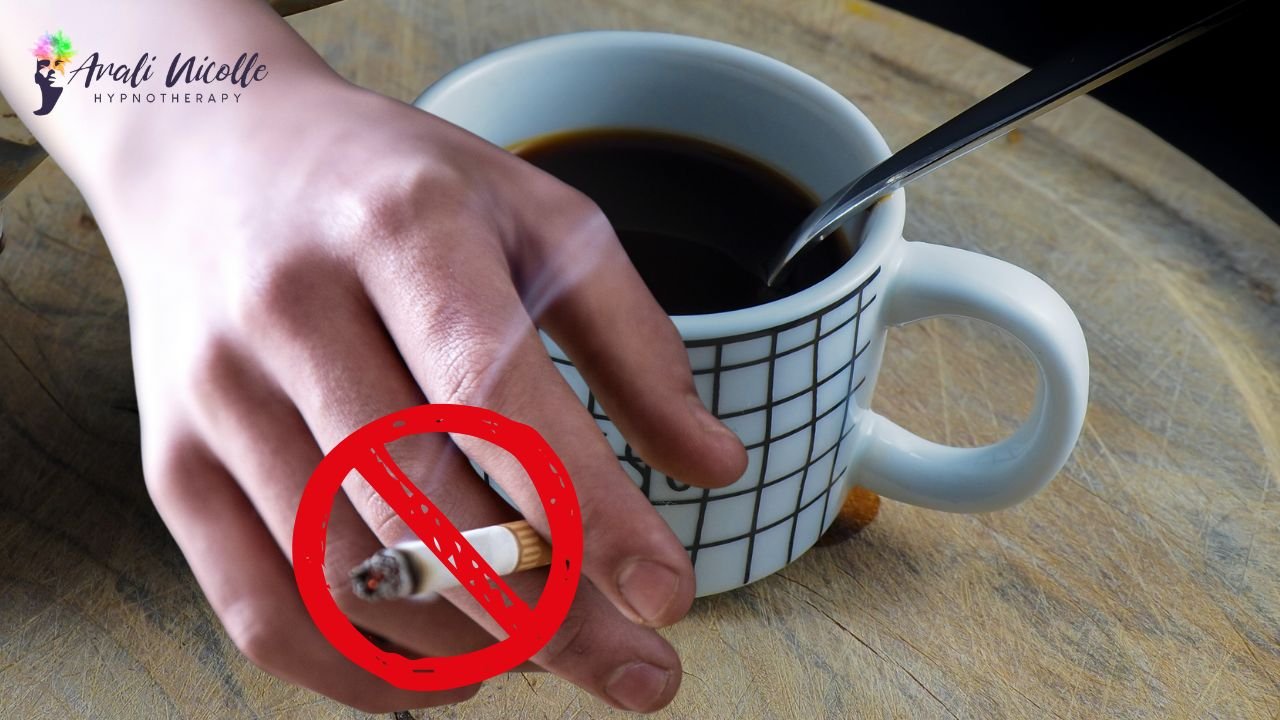
If you’ve ever wondered why certain moments make you want to smoke more than others, you’re not imagining it. There’s a reason your brain links cigarettes to coffee, driving, drinking, stress at work, or even boredom. These aren’t random triggers. They’re conditioned associations your mind has built over years.
Let me explain it the way I wish someone had explained it to me when I smoked.
Your subconscious mind loves pairing experiences together. If you’ve smoked while drinking your morning coffee enough times, your brain starts to believe the two go together. It’s like they become one memory. So when you decide you’re going to quit, the coffee itself can trigger a craving—because your mind assumes a cigarette should follow. If you’ve asked, “Why do I crave cigarettes with coffee?” it may be because the smell, mug, or place where you drink it has become a cue. For some people the morning urge also coincides with going overnight without nicotine. Consider the timing before deciding that coffee itself is the whole problem.
This is why quitting often feels harder in certain situations. You’re not craving nicotine. You’re craving the pattern your brain expects.
How Coffee and Cigarettes Become a Cue to Smoke
Let me walk you through how this works on a neurological level—but I promise I’ll keep it simple.
Every time you perform a behavior, your brain creates a pathway. Think of it like walking through a field of tall grass. The first time you walk through, you’re forging a new path. It takes effort. But if you walk that same route every single day for months or years, eventually you create a clear, worn trail. That’s what happens in your brain with repeated behaviors.
When you smoke a cigarette while drinking coffee, your brain releases dopamine—a feel-good chemical. It doesn’t just associate the dopamine with the nicotine. It associates it with the entire experience: the coffee, the warmth of the mug, the time of day, the location, even the people you’re with.
Over time, your brain learns: “Coffee = cigarette = dopamine = good.”
Now coffee isn’t just coffee anymore. It’s the first half of a two-part ritual. And when you try to quit, your brain is confused. It’s like showing up to a concert and the opening act never comes out. Something feels incomplete.
This is called classical conditioning, the same process that made Pavlov’s dogs salivate at the sound of a bell. Your brain has been conditioned to expect a cigarette in certain contexts, and when it doesn’t get one, it sends you a craving signal.
Why a Smoker May Smoke When They Drink Coffee
Different people have different triggers, but certain patterns show up again and again. Here are the most common smoking triggers I see with clients:
Coffee and Cigarettes
This is the big one. For so many smokers, coffee and cigarettes are inseparable. Why? Because caffeine is a stimulant, and nicotine is also a stimulant. Together, they create a specific feeling—alert, focused, energized. Your brain has learned to associate that feeling with having both substances at once. Researchers in a meta-analysis of 128 publications found that tobacco cues raised ratings of craving compared with neutral cues. The analysis covers many cues and doesn’t isolate the first cup of coffee. In your own routine, see what happens when you drink the same coffee in a different seat or make it after breakfast. It may be the sequence that matters more than the drink.
When you quit smoking but keep drinking coffee, your brain is expecting the second half of the equation. The coffee alone doesn’t produce the same effect, so your mind interprets that as something being missing.
Alcohol and Smoking
Alcohol lowers inhibitions. It also impacts the prefrontal cortex—the part of your brain responsible for decision-making and self-control. This is why people who haven’t smoked in weeks will suddenly find themselves bumming a cigarette at a bar. If alcohol and smoking went together for you, decide what you’ll order and where you’ll sit before meeting friends. You could choose an alcohol-free drink or spend time with people who won’t take smoke breaks. Ask one friend to stay with you while others step outside if that would make the evening easier.
But there’s another layer to it: social conditioning. If you’ve spent years smoking while drinking, your brain has linked the two experiences. A drink in your hand becomes a trigger, just like coffee.
Stress and Cigarettes
This is the most emotionally loaded trigger. When you’re stressed, your body goes into fight-or-flight mode. Your heart rate increases, your breathing gets shallow, cortisol spikes. A cigarette—counterintuitively—feels calming.
Here’s why: when you smoke, you take a deep inhale. You pause. You exhale slowly. That physical act of deep breathing actually does calm your nervous system. But your brain credits the cigarette, not the breathing.
Over time, your mind learns: “Stress = cigarette = calm.” So when you quit, your brain doesn’t know how to downregulate stress anymore. It only knows one solution, and you’ve taken it away.
Boredom and Smoking
Cigarettes give you something to do. They fill empty moments. If you’re someone who smokes when you’re bored, your brain has learned to use cigarettes as a way to create stimulation when there’s nothing else happening.
This is especially hard to break because boredom is everywhere. Waiting in line, sitting in traffic, scrolling on your phone—these are all moments where your brain used to default to smoking.
After Meals
Smoking after eating is another deeply ingrained pattern. There’s even a physiological component: nicotine can increase metabolism and suppress appetite, so your brain has learned to “complete” a meal with a cigarette. After meals, experiment with an ending that doesn’t send you through the smoking area. Clear your plate, brush your teeth, or go for a short walk a different way. Try one change for a few meals so you have a chance to see whether it affects the urge.
But the bigger factor is ritual. For many smokers, the cigarette after a meal is the reward. It’s the punctuation mark at the end of the experience. Without it, the meal feels unfinished.
How to Drink Coffee Without Reaching for a Cigarette
Try moving the cup to a different table while keeping the coffee the same. If you usually smoke when you drink coffee on the patio, a different place can interrupt the sequence. Notice when the urge to smoke begins. Some people who smoke are reacting to a familiar cue, and others are already feeling nicotine withdrawal before they pick up the mug.
Caffeine, Nicotine Withdrawal and Cigarette Cravings
Nicotine withdrawal can be mild for some people and disruptive for others. The National Cancer Institute describes both withdrawal and urges tied to situations. If you have cravings throughout the day, ask a clinician about smoking cessation support. Tell them that coffee is one trigger but also mention what happens when you don’t have coffee.
But pattern-based cravings? Those can last for months. Because they’re not about nicotine. They’re about context.
You can be completely nicotine-free and still get hit with a powerful craving when you’re in a situation where you used to smoke. That’s your brain recognizing the context and expecting the behavior that usually follows.
This is why so many people relapse weeks or even months after quitting. They think they’re “over it,” and then they’re at a wedding, or a stressful day at work, or having drinks with friends, and suddenly the craving is back at full force.
They didn’t fail. Their subconscious just recognized a familiar pattern and tried to complete it.
How Can a Smoker Quit Smoking and Still Drink Coffee?
For someone trying to quit smoking, coffee and cigarettes can be a familiar pair. Change one element of the usual morning routine. For example, drink coffee in a place people use for breakfast instead of the place where people smoke. If you experience an urge to smoke before coffee, ask a healthcare provider about withdrawal and nicotine addiction.
Rehearsing a New Response to Smoking Triggers
A hypnosis session may help you rehearse a different response to a familiar trigger. Evidence for hypnosis as a quit-smoking treatment is uncertain, and a rehearsal is only one piece of a quit plan.
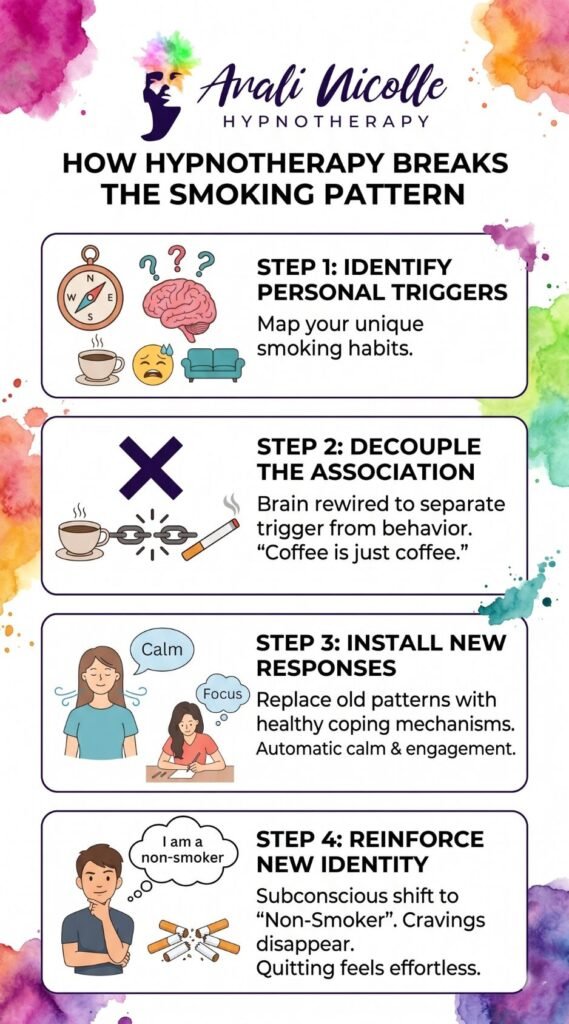
Here’s what that process looks like:
Step 1: Identify Your Specific Triggers
Not everyone has the same triggers. In our sessions, we map out your personal smoking patterns. When do you smoke? What are you doing? How are you feeling? What does the cigarette do for you in that moment? When you track a morning craving, write down whether it started before you poured the coffee and whether another familiar part of breakfast was different that day. Three mornings can give you enough detail to choose one change without guessing.
This isn’t just data collection—it’s awareness. Many people have never consciously examined when and why they smoke. They just do it automatically.
Step 2: Decouple the Association
Once we know your triggers, we use hypnotherapy to rewire the connection between the trigger and the behavior.
For example, if coffee is a trigger for you, we work with your subconscious to separate the two experiences. We create new associations. Coffee becomes a moment of calm, of warmth, of starting your day—without needing a cigarette to complete it.
This isn’t willpower. This is retraining your brain at the level where the habit actually lives.
Step 3: Install New Responses
It’s not enough to just remove the old pattern. Your brain needs something to replace it with. Pick one change that you can keep on a busy morning. Leave a note beside the mug reminding you where you’ll drink it and what you’ll do if a craving hits. If you usually buy cigarettes on the way to work, decide whether you can take another route for the first week.
If you used smoking as a stress reliever, we install new ways to calm your nervous system—deep breathing, grounding techniques, healthier coping mechanisms that your subconscious can default to automatically.
If you smoked when you were bored, we help your brain find new ways to create stimulation and engagement without needing a cigarette.
The goal is to give your subconscious mind new programming—new pathways that are just as automatic as the old ones, but healthier.
Step 4: Reinforce Your New Identity
One of the most powerful parts of hypnotherapy is identity work. When you see yourself as “a smoker trying to quit,” you’re still holding onto the smoker identity. Your mind is still thinking of cigarettes as something you want but can’t have.
But when your subconscious shifts to “I am a non-smoker,” everything changes. You’re not resisting cigarettes anymore. You simply don’t identify with them.
That’s when clients say things like, “I walked past someone smoking and it didn’t even appeal to me,” or “I was at a bar with all my smoking friends and I genuinely didn’t want one.” The identity shift makes quitting feel effortless.
Coffee, Cigarette Smoke and Nicotine Addiction
People trying to quit smoking sometimes change caffeine intake as well as their smoking routine. If coffee makes you feel jittery after you stop smoking, consider a smaller serving or a different time, and ask a clinician about persistent symptoms. A behavioural plan addresses the usual cue, while a tobacco treatment plan can help with nicotine addiction and withdrawal.
What Happens When Triggers Lose Their Power
When your brain stops linking cigarettes to coffee, stress, alcohol, and boredom, something remarkable happens: you get to enjoy those moments again.
Coffee tastes better. You’re not distracted by a craving. You’re just drinking coffee.
Stress becomes manageable. You learn to sit with discomfort without needing to escape it with a cigarette.
Social situations feel normal. You don’t feel left out or deprived. You just feel present.
That’s when you know your brain has rewired itself. And once you experience that freedom, you’ll never want to go back.
FAQ: Your Most Common Trigger Questions
Why is my morning coffee the hardest part of quitting?
Because your brain fused the ritual into one experience. We break that connection.
Why do I crave cigarettes when I’m bored?
Your brain used cigarettes as stimulation. When the pattern dissolves, the urge disappears.
How long do these pattern cravings last?
Until the subconscious association is rewired. With hypnotherapy, this happens quickly.
Will I always crave cigarettes with alcohol?
No. Once the subconscious identity shifts, the context loses its power.
What if stress is my biggest trigger?
We rebuild your internal stress-regulation system so you no longer rely on cigarettes to calm your nervous system.
Ready to Break the Coffee-Cigarette Loop for Good?
If you’re tired of your triggers running your day — mornings, meals, stress, boredom, nights out — you don’t have to white-knuckle them anymore.
When the subconscious pattern dissolves, triggers stop being triggers.
If you’re ready to drink your coffee as a non-smoker — effortlessly — book a free Clarity Call.
